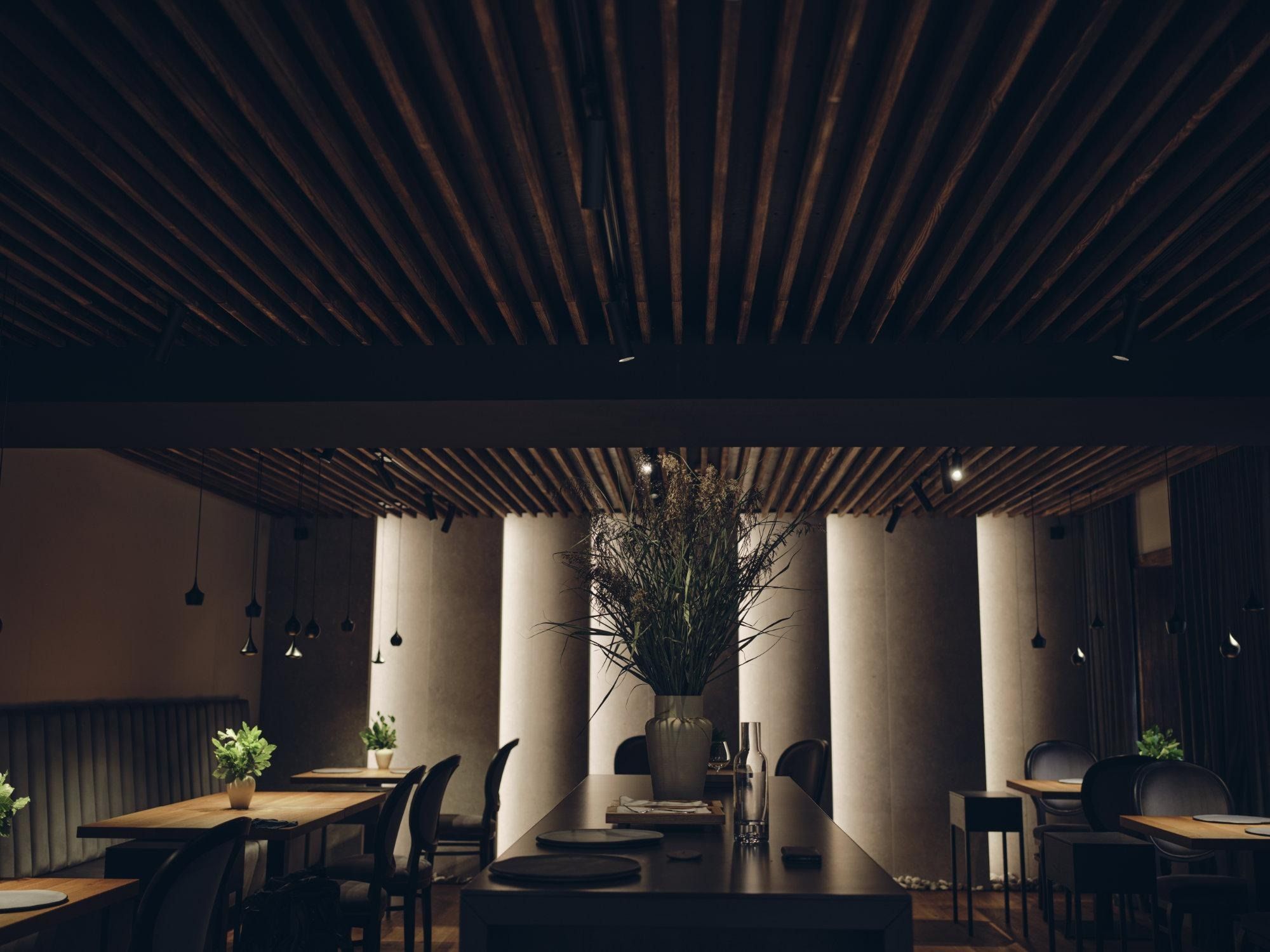
Milka: At Lake Jasna, below the summits of the Julian Alps and with a touch of Scandinavia
- Words by
- Kaja Sajovic
- Photography by
- Suzan Gabrijan
May 9, 2022
What is the recipe for success? Mix a little Nordic, a little Alpine cuisine, a little of the idyllic scenery of the Julian Alps and a little cosmopolitan flair.
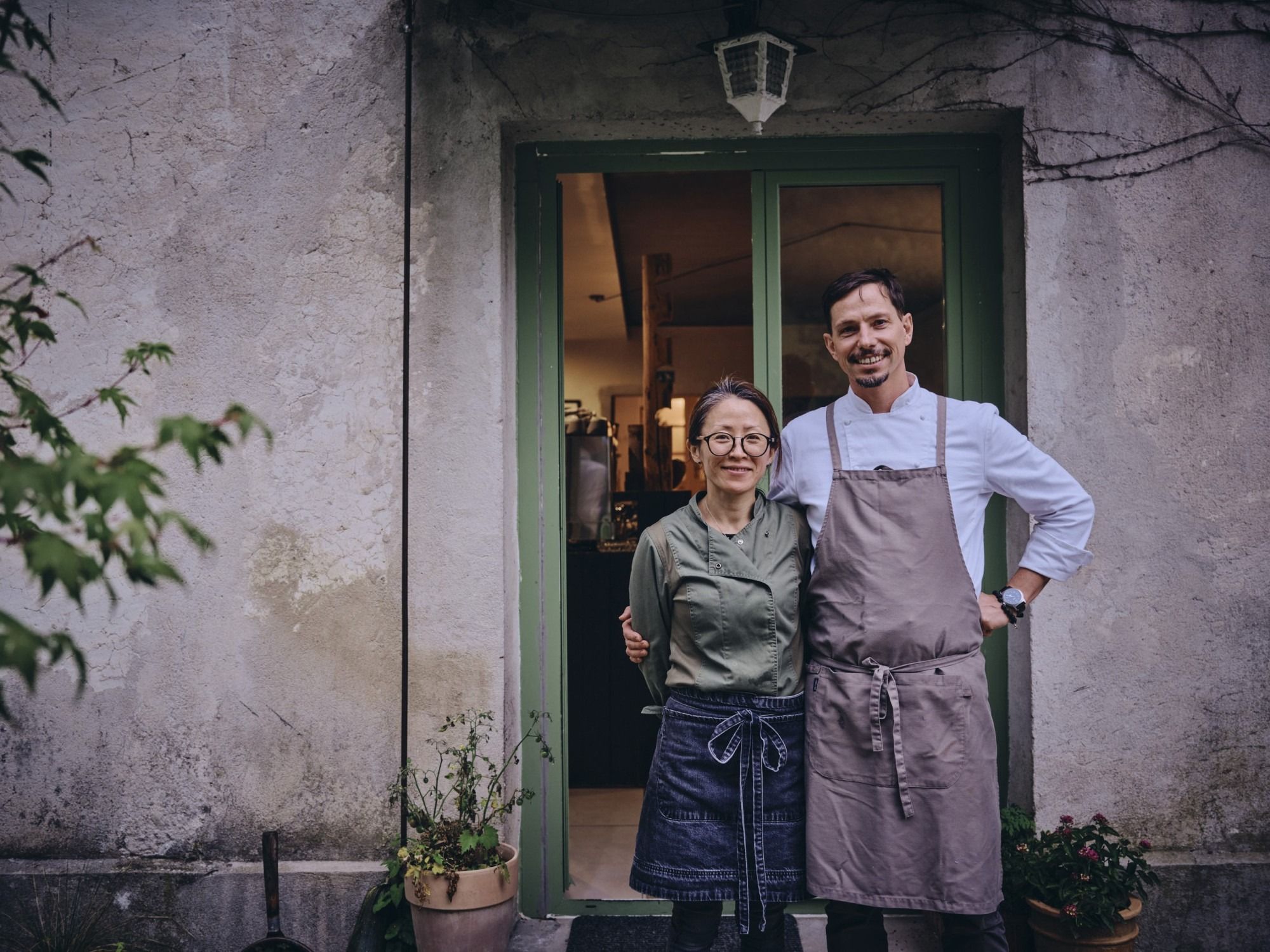
This is Milka in Kranjska Gora, the recipient of two Michelin stars in Slovenia and a true phenomenon on the local gastronomic scene. The restaurant achieved remarkable recognition just three months after opening, when the inspectors awarded it a star, and it is led by chef David Žefran, who creates dishes with a distinctive style and bold vision.
Photo: Suzan Gabrijan
It almost seems like the biggest success stories in our country are written by self-taught chefs, at least if we look at Ana Roš from Hiša Franko (3***) and Žefran, who got into this business by flipping burgers at Tiskarna, somewhere between a Master’s degree in analytical sociology and playing music as DJ Žefran. Then he was at Eko for a while, followed by Luda and Atelje, but nowhere for more than a year.
You’d never know it. Žefran’s cuisine is incredibly precise, aesthetically refined and with bold but balanced flavours. One of the stand-out dishes on the autumn menu is cabbage in Tolmin cheese sauce with crispy leek hairs, black lemon paste, leek emulsion, coffee oil, sherry and pine nuts. A complex, multi-layered dish with a lingering aftertaste that continues to evolve and develop in the mouth with new and exciting notes, without one overpowering the other.
Photo: Suzan Gabrijan
Žefran walks a fine line with dishes that tend towards satiating and filling umami, unmistakably Nordic-inspired, working a lot with fermentations, koi, garums and everything else you’d expect from someone who keeps The Noma Guide to Fermentation (2018) like a bible on one of the sun-drenched wooden shelves in the bright, elegant dining room of the boutique hotel Milka.
But perhaps even more than Noma, Žefran was influenced by Frantzen, a three-star heavyweight from Stockholm, where he spent a short time as a trainee. Their focus is on the hedonistic experience, on the hospitality they offer their guests, on that feeling of comfort and enjoyment of the food.
Photo: Suzan Gabrijan
This aspect particularly appealed to Žefran, a perfectionist by nature with a clear vision, and this is what he is now trying to conjure up in Milka – to create a space where guests are completely absorbed by Milka’s “living room”, Milka’s magnificent show overlooking the fairy tale Lake Jasna and the majestic peaks of the Julian Alps above it. “From the start, I had a clear vision ofwhat I wanted to achieve. The star came really quickly, but the boys are ready,” he explains without false modesty. This focus, without half-heartedness, is certainly something that is very noticeable.
At the table next to ours at lunch was a younger American couple, back for the second time in a week. They said they didn’t mind if some of the dishes were the same – they liked the food so much. “The dish has to be complex, but I don’t want to go avant-garde, which could be a bit contradictory to my main goal – to make the guest feel good in Milka, to make him happy and satisfied with the food,” Žefran explains of his philosophy.
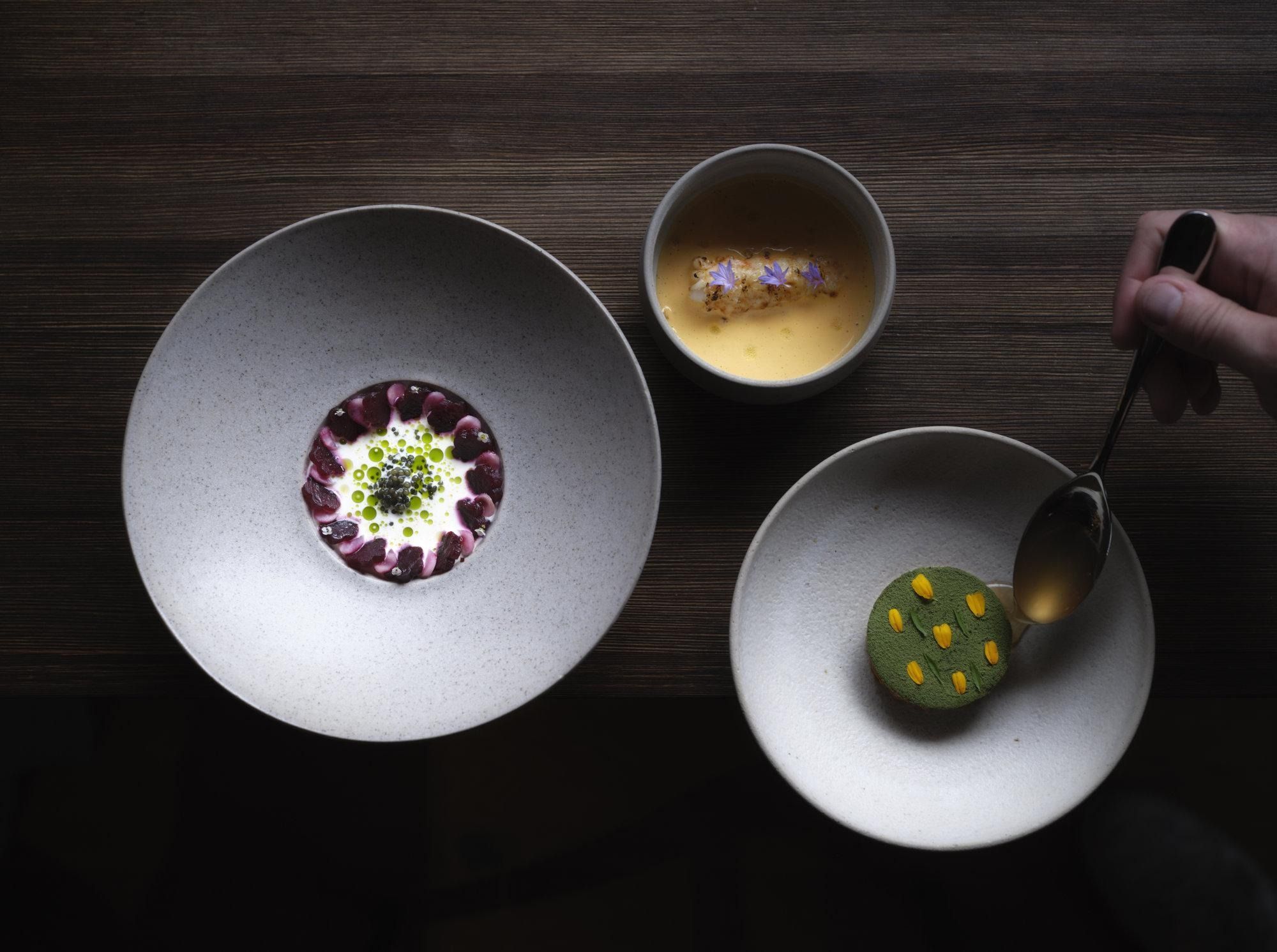
Photo: Suzan Gabrijan
One such example is his beetroot dish, which at first glance looks like one of those beetroot, cream and caviar combinations you’ve seen before – but it’s still a Žefran dish, a perfect example of the Nordic world merging with the Alpine world. The beetroot is steamed in spruce branches, the second part is beetroot pickled in spruce tip vinegar, and the whole is topped with cream with lardo and fig leaf oil.
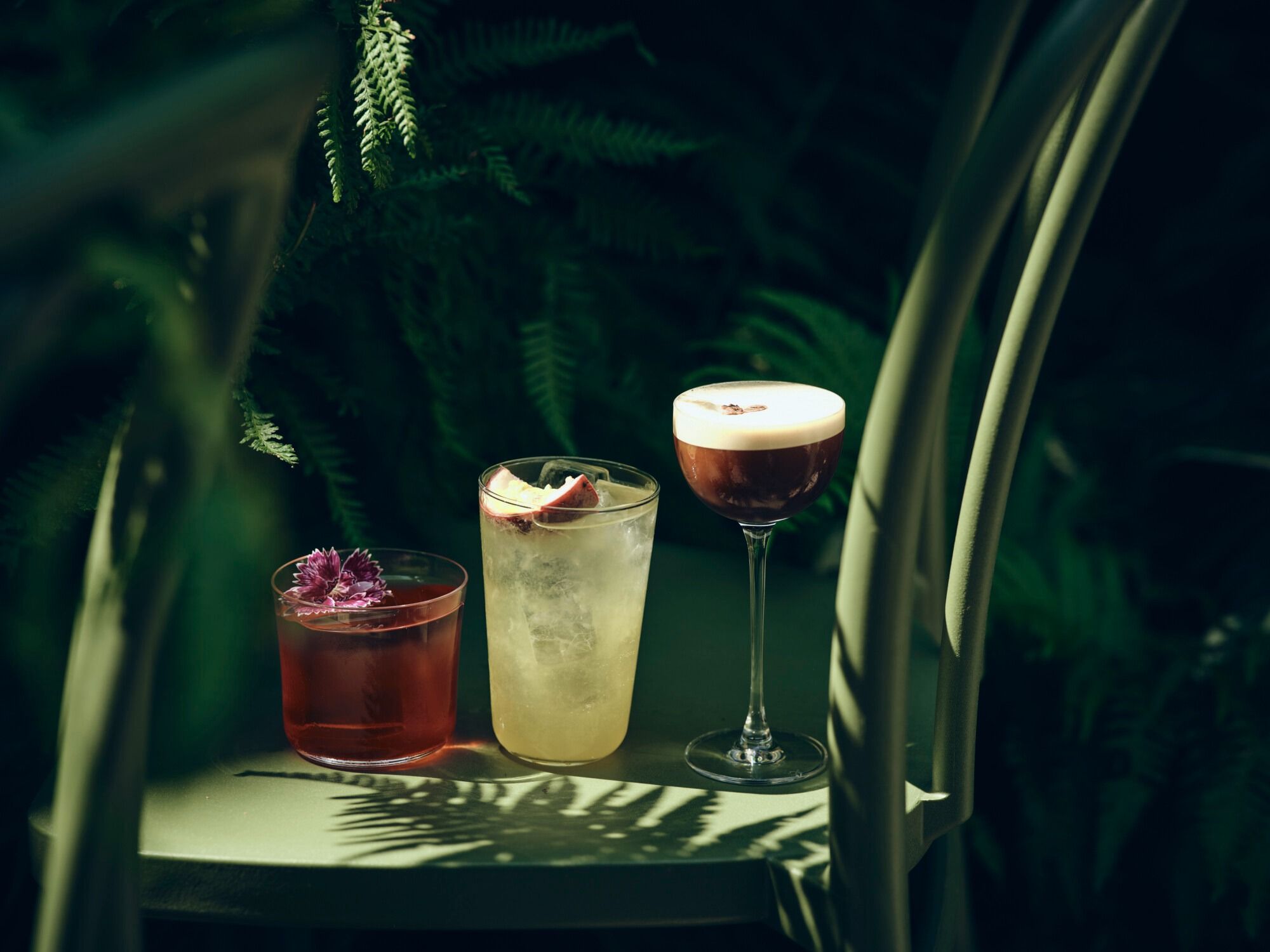
The dish is accompanied by čremse syrup, local wild cherries with vanilla, fig leaf essence and red grape juice, one of the many creations of the master cocktail maker Dominik Gobec, who is in charge of non-alcoholic pairing at Milka.
Combinations of kombuchas, water kefirs, fermented juices and teas are becoming an increasingly trendy alternative to wine accompaniments in the world of haute cuisine, especially if you have to drive after dinner. And Milka has been very ambitious about it. With drinks based on rooibos, oolong and other teas and verjus, they can cover the menu from start to finish, served in elegant Rogaška Slatina wine glasses, as Gobec notes that this immediately makes guests feel equal to those who reach for an alcoholic pairing. Details matter, and this is reflected in Milka at every turn.
Photo: Suzan Gabrijan
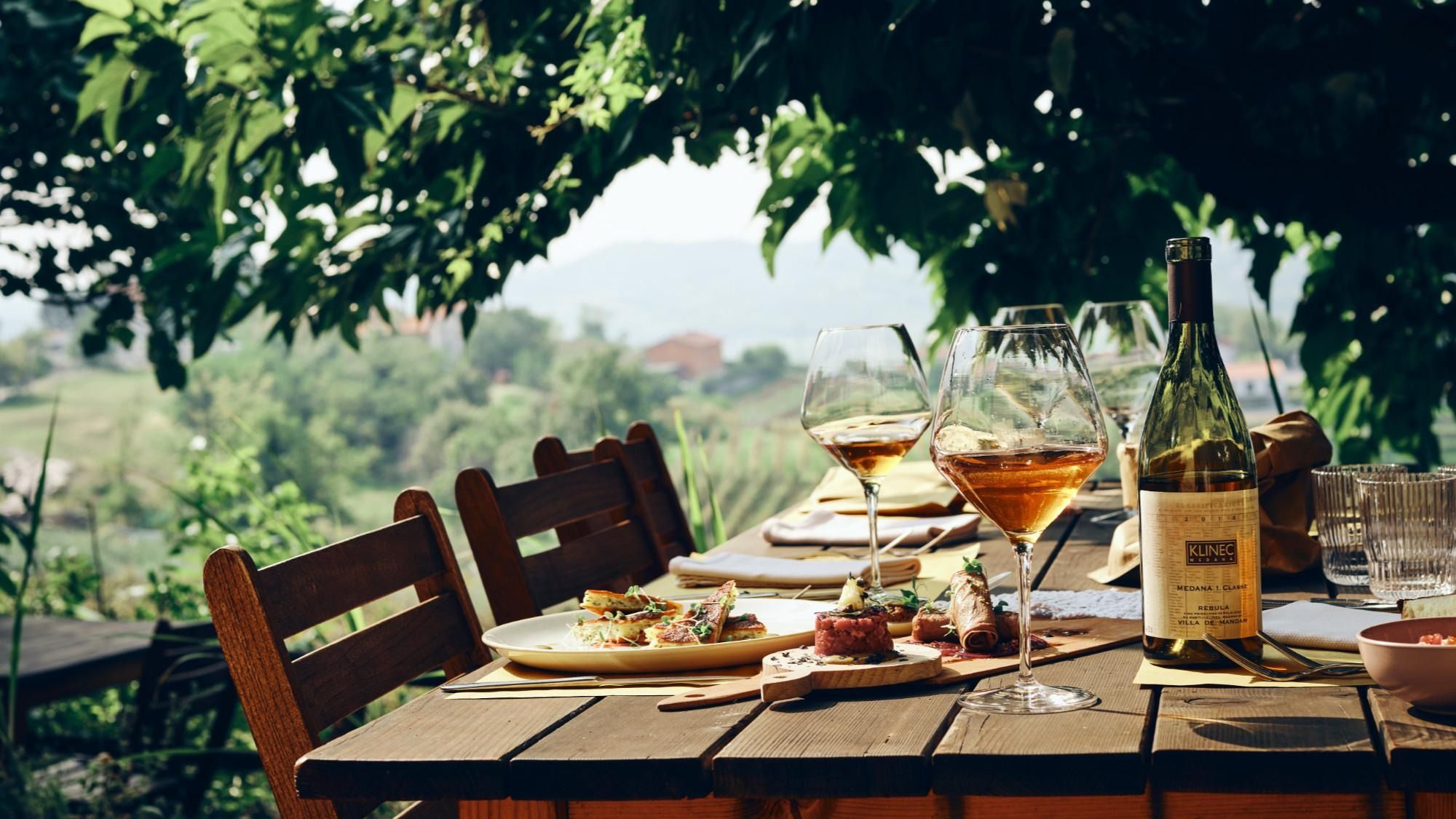
When it comes to wine, they promote mainly indigenous Slovenian varieties on the one hand and sustainable wines on the other, and the winery is well stocked with several prestigious labels befitting a restaurant of this rank.
Sommelier Lenart Plavčak, who spent several years in Austria, says that foreigners are mostly looking for local and indigenous wine accompaniments. “We have the advantage that you can give a guest four glasses of Rebula wine and each one will be completely different from the next. From sparkling wine to macerations,” he explains, as he pours a welcoming house Chardonnay, Riesling and Ranfol from winemaker Peter Jankovič from Rogaška Slatina, a really small producer who works almost exclusively for Milka on his organic plot.
Photo: Suzan Gabrijan
The label is a stylised mountain with a setting sun and the letter “M”. Milka. The table is decorated with ceramics by four Slovenian ceramicists and bouquets of beech leaves. The restaurant and the hotel are really building on branding, on building a brand that they want to make synonymous with quality and a kind of boutique luxury that is still in the starting phase in Slovenia.
Milka’s story was thus rewritten from scratch, on the foundations of the old boarding house, of which not much remains. The hotel is the work of the Gartner architectural firm, under the direction of manager Dino Katalenić, who brings to Kranjska Gora a wealth of experience from five-star hotels abroad.
Milka is a luxury hotel that definitely ranks among the very top of the Slovenian offer, while also strictly following the ecological note – all cosmetics are natural, they try to have as little packaging as possible, there are no plastic doses in the coffee machine, the blankets and decorative pillows are made of pure wool, and the towels are made of 100% cotton.
Photo: Suzan Gabrijan
There are six rooms that are all about comfort – king-size beds, intimate, dim lighting, a giant bathtub in the middle of the room, all in light tones, stone and larch wood, a jacuzzi on the terrace and views of the mountain scenery. As they say, their guests have very different needs, from those who want a mountain guide for a hiking tour to those who are after a gourmet experience, but money is no object, so they can also order a helicopter transfer to Hiša Franko. The limit is, literally, the sky.
In their mission to create a special guest experience and place them in their surroundings, they don’t improvise even at breakfast, which is a truly impressive display of all that the area has to offer – the wait staff bring us dish after dish after dish – here’s the home-made churned butter, three types of excellent sourdough bread and bread with seeds, glistening slices of smoked trout with trout roe and horseradish spread on the side, home-made jams and cajeta (goat’s caramel spread).
Photo: Suzan Gabrijan
Gorenjska is a land of hunting and game, so there is no shortage of salamis (bear, deer, chamois), dairy products, from cheese to sour milk, are sourced from the Pr’ Hlebar farm above Martuljek, and honey from the Toni bee-keeping farm in Rateče, where there is a bee-keeping apiary at an altitude of 1,200 metres, and, as they say, the flavour of such a floral honey is really unique.
“Here in the valley, everything has been plundered and is extinct, but up there on the mountain there are still medicinal flowers, St. John’s wort, gentian… it’s all in our honey,” explains beekeeper Toni Zupanič, who has been working with David for the past year and on that very day he was joined by an international Netflix crew filming their new documentary series about the inhabitants of the Alpine world.
Photo: Suzan Gabrijan
The fact that they really try to be as local as possible is evidenced by the fact that they serve only cow’s milk, because this is the Alpine world (forget about soy and almond substitutes), instead of orange juice, because oranges don’t grow here, they serve apple and peach juice and the coffee is roasted in Slovenia by Čokl.
As Žefran tells us, the aim is to find ingredients and suppliers within a 150-kilometre radius, which means that they don’t mind going as far as Italy or Austria, as long as it’s a quality supplier from a more or less similar mountainous environment. Also, unlike many chefs today, Žefran expressly refuses to use the term “sustainable” when describing his restaurant, as he is critical of the so-called “green washing”, preferring the term “responsible”.
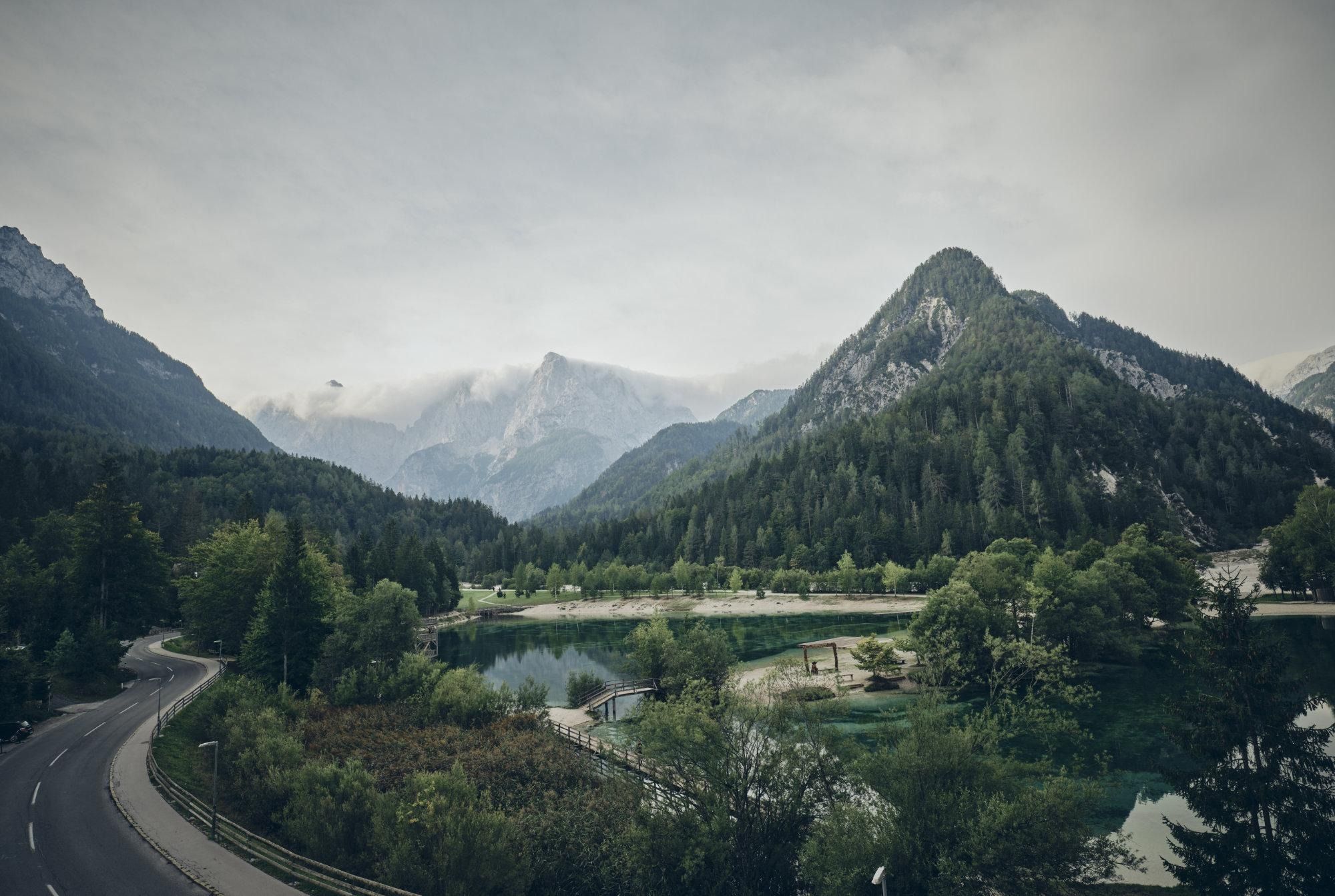
Photo: Suzan Gabrijan
Above all, they try to be as self-sufficient as possible, which is also evident in the wide range of spirits served at the end of the tasting menu – from bay brandy to strawberry brandy with pine cones, from corn liqueur to chanterelle liqueur, inspired by a visiting local who always had chanterelle mushrooms soaked in rum under the table. “I would like to build on this concept of mountain cuisine. I really want to capture space and time. We have good products, which is the basis for everything,” explains the chef, who says he is a very visual type and gets most of his inspiration from the garden, through associations.
Asked what his goals are, given how quickly he got his star, he says his challenge is mainly how to change the system and the kitchen culture and how to make the working environment more sustainable and friendlier, which is something that is being talked about a lot nowadays, especially abroad.
Photo: Suzan Gabrijan
“I love the hospitality industry, the passion of people in the hospitality industry, all the different characters you get to know in the business. But the toll on your personal life is very high,” he explains. “In these six years, I have gained a lot of experience of what it is to be a chef and, above all, what it *isn’t* to be one. It’s one thing to cook, but it’s another when you get to the point where you have to work with people. It’s a challenge, but it excites me. Being a mentor to young people is one of the most exciting aspects for me at the moment.”
Photo: Suzan Gabrijan
Photo: Suzan Gabrijan
Photo: Suzan Gabrijan
Photo: Suzan Gabrijan
01/04
Stories