Klinec: Two brothers, prosciutto and orange wine with a view to Goriška Brda
- Words by
- Kaja Sajovic
- Photography by
- Suzan Gabrijan
July 6, 2021
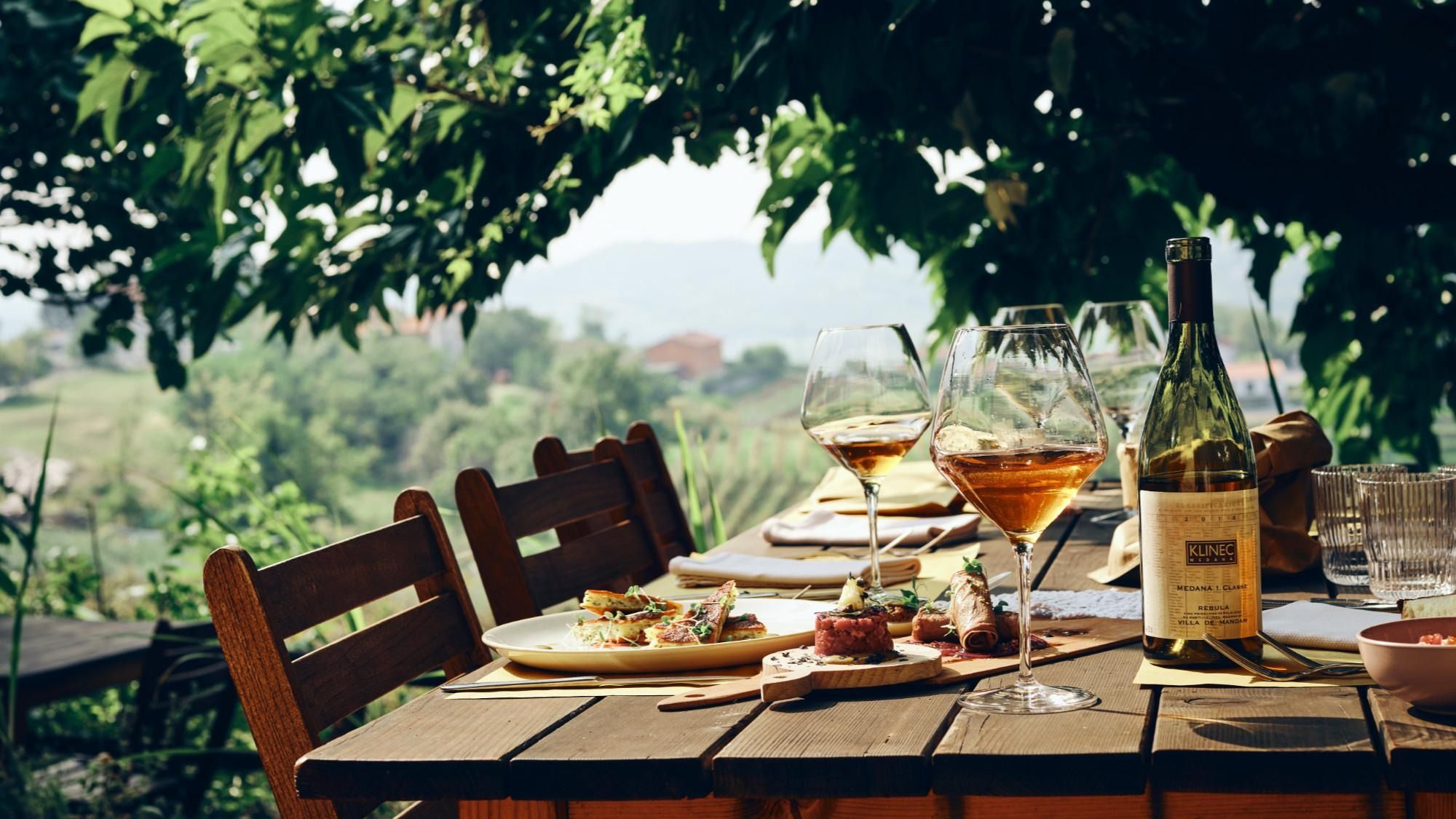
The sign "No Pizza, no Coca-Cola, no Pommes Frites" greets visitors at the entrance door of the Klinec Homestead in Medana known for its sustainably produced wines and excellent cuts of meat, all served on one of the most beautiful terraces in Goriška Brda.
Maybe it’s the deep shade of the mulberry tree under which you are sipping a glass of amber-coloured Rebula, maybe it’s the view that stretches all the way to Italy, or the smell of the smouldering wood of the grapevine used by Aleks for the open fire.
Once you visit the Klinec family, you effortlessly become their regular guest. You stop by for “just one drink” and wake up somewhere in the Brda region—wherever the group ends up that night.
Wine and food are a story of their own, but it is the homeliness and the innate sense of hospitality that keep you coming back to Medana, a place so inextricably linked to the story Slovenian wines’ success abroad. It was the entrepreneurial folks from Brda with their natural attachment to Italy who first broke free from the shackles of cooperative mass-production in winemaking and focused on boutique family wine-growing with an emphasis on quality.
Photo: Suzan Gabrijan
Viticulture from the cradle
One such Brda resident is Aleks Klinec, the fifth-generation winemaker who was among the first in Slovenia to turn to strictly organic production practices at a time when many mocked him for digging his own grave with macerated, unfiltered wines, with no added sulphur, and a complete return-to-nature approach when it came to working in the vineyard without herbicides, pesticides and artificial fertilisers. Living soil, living wines.
He has not succumbed. He is after all a Bric, as the residents from the Brda are called. Like the hospitality industry and wine growing, walking against the wind has also been with him since the cradle. His mother comes from a family that was engaged in the hospitality industry and as a little girl, during the Italian occupation in the Second World War, she moved the boundary markers that divided the Brda villages and with them entire families, and thus “returned” with her own bare hands her home village to Slovenia. When she grew up, she crossed the border with a bit less secrecy to help Joško Sirk from La Subida.
Photo: Suzan Gabrijan
Times have changed—these days, even Italians from the very tip of the “boot” travel all the way here to eat and drink at one of the Klinc family’s estates. “Che meraviglia,” “How wonderful,” exclaim a group of Sicilian winemakers and wine importers one afternoon, sitting at a wooden table beneath vines that stretch across the terrace. Honey-colored Malvasia is poured into glasses, and if you catch the light at just the right angle, you might spot Krško-Polje pigs rooting around the edge of the vineyard.
Photo: Suzan Gabrijan
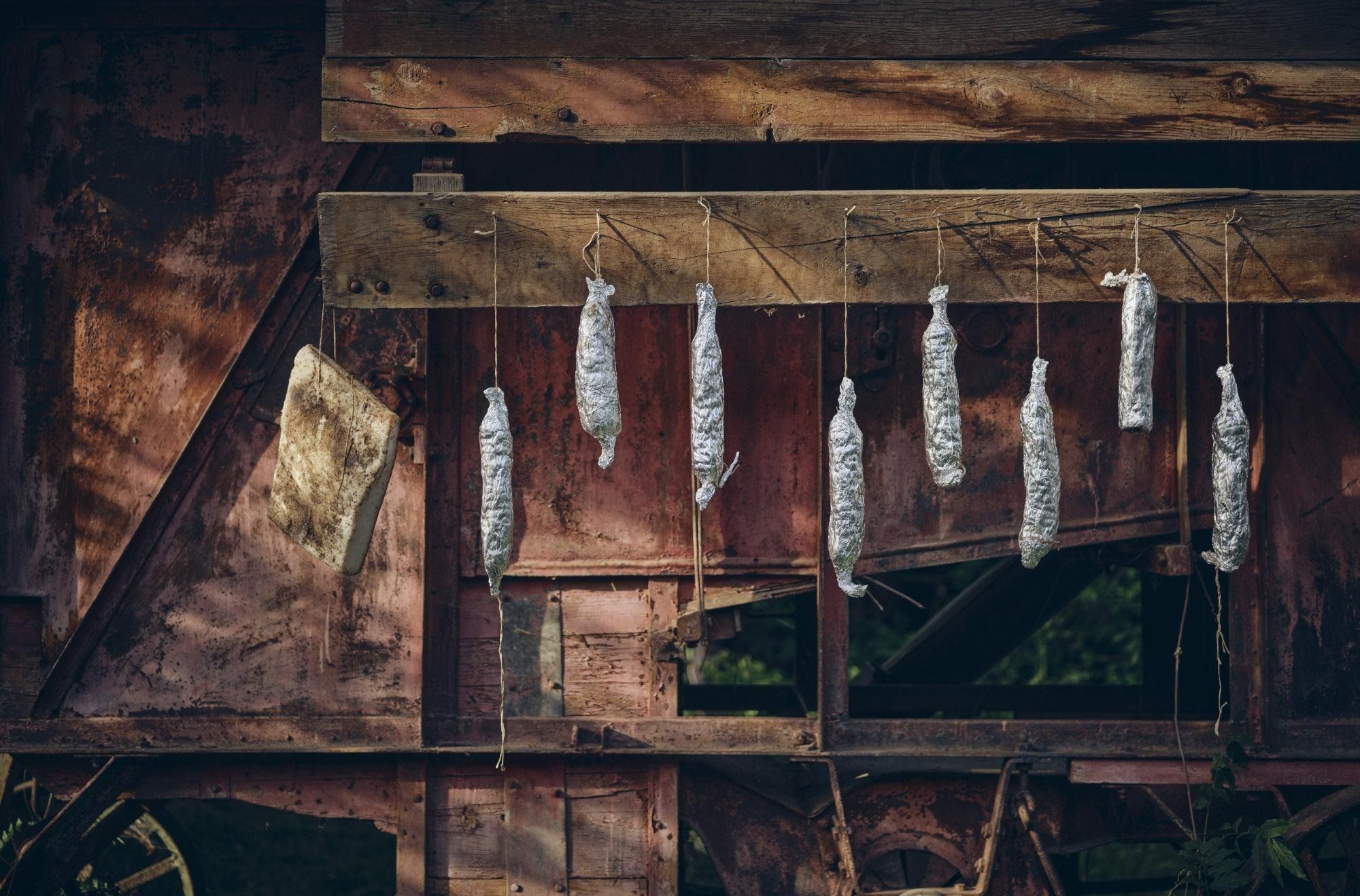
The same pigs that a moment later appear in front of you as an assortment of deliciously smelling cuts of meat, prosciutto, salami and pancetta, all made by the Klinec family. This is not the ideal place for vegetarians and the Klinec family managed to convert quite some of them. If anywhere, then here.
Klinec wines are known for their complexity, depth, and richness. These are wines that capture the spirit of the Brda region. Malvasia is replaced by Ortodox (a white local wine), then Gardelin (Pinot Gris), and finally Mora (velvety wine, a blend of Merlot and Cabernet Franc).
Photo: Suzan Gabrijan
Wine and art
The visitor can feel the homeliness in every pore of the rustically furnished homestead, ranging from the homemade brandies in the giant glass bells behind the counter, the open fireplace to the bouquets of colourful wild flowers adorning the tables.
The central dining room presents a link between the past and the present with an old chest, grandmother’s clay models for potica cake and a crucifix in the corner, and modern canvases on the walls, bearing works produced at the art colony hosted by the Klinec family for over 20 years.
Both families, that of Aleks and his brother Uroš, have always been closely connected with art and have supported painters, poets and musicians from all over the world. Aleks was the one who started the Days of Wine and Poetry in Brda in 1997, at a time when Medana was still considered a place at the end of the world.
Boutique tourism? Forget it. These were the times when guests were sleeping in barns and on the winemakers’ sofas. Today, accommodations are no longer a problem and the Brda region has become a destination that equally attracts foreign and domestic guests to the point that it is often impossible to find a spare bed over the weekend. And believe me, after all the wine, you’ll need a bed.
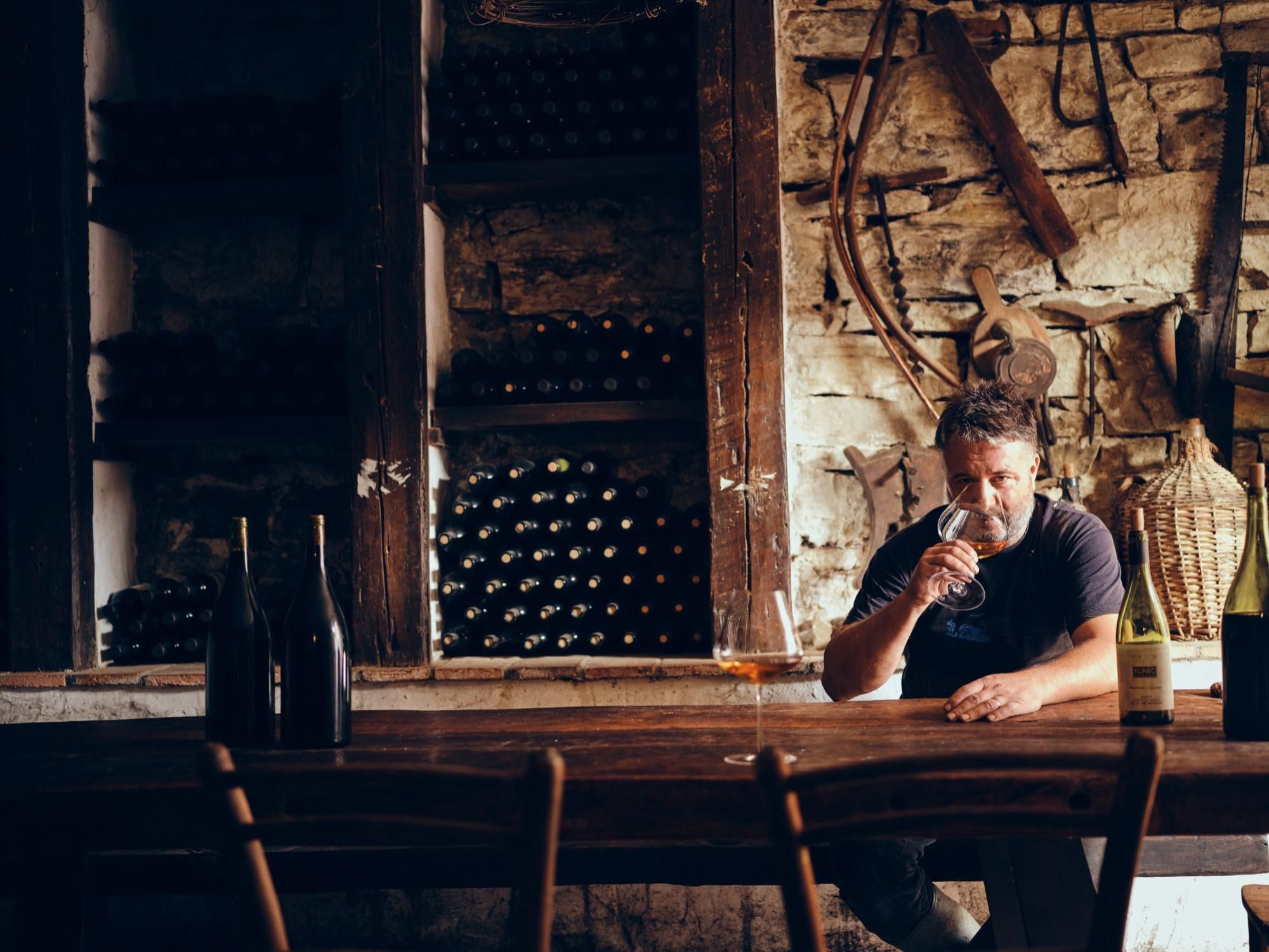
Photo: Suzan Gabrijan
At Nejka and Uroš's Homestead
Among the most visited places in Brdo is definitely the Lower Klinec Homestead, Klinec Plešivo, run by Aleks’s brother Uroš and his wife Nejka. If the upper homestead is distinguished by genuine warmth that takes you back to another time, embraces you with homeliness and sates your carnivorous-wine impulses, the lower Klinec Homestead is a more modern, polished version of all the above.
“Enjoy the little things,” says the decorative pillow on the armchair standing on the breath-taking terrace. “The good things in life are meant to be shared” is another quote on the wooden board next to the breakfast table. From there you can enjoy an excellent view to the estate of Marjan Simčič in Ceglo, to La Subida on the Italian side of the border, and to the open fireplace where Uroš is confidently turning beef cheeks, giant Florentine steaks or some other piece of meat he gets from the local farmers.
Over the years, Nejka and Uroš have become a synonym for the combination of the entrepreneurship and innate hospitality so typical in the Brda region. Nejka is in charge of the impeccable modern design and the interior of the complex, which resembles more of a stroll through a modern art gallery than a boutique hotel.
Photo: Suzan Gabrijan
A boarding house that could be a gallery
Years of artists’ colonies have left their mark in this homestead too, transforming the entire dining room into an exhibition space of hand-painted bottles, plates and ceramic tiles, over which the Last Supper painted by Klemen Brun, a painter form Nova Gorica, dominates.
A close friend of the Klinec family was the late Etko Tutta, an artist from the Brda region, who designed one of the five guest rooms. Each room is the work of different artist and each has its own features – from the more avant-garde to romantic in red.
Photo: Suzan Gabrijan
Apart from Tutta, Franco Dugo, Boris Zaplatil, Jože Skubic and Rudi Skočir have left their mark here; it seems, however, that the view of the picturesque vine-growing hills from all the rooms is still the most impressive canvas of all. The mists rising slowly over the green fields paint landscape settings that in the window frame really look as if they have been painted with a fine paint brush.
The corner of your eye spots a bit of turquoise interrupting the green – a pool with a view – while the vine-covered pergola is hiding a row of tables outside, decorated with pots of lemon, olive and rhododendron trees.
Photo: Suzan Gabrijan
A tribute to the seasonal and local
Everything served is seasonal and, where possible, locally produced by small farmers in the wider region. Goat curds from the Žerjal Farm in Tomaj are always on the table. Vegetables are from the nearby farms and so are the apple, elderberry and mint juices. The organic rye and spelt flakes are stone-ground, cheeses are produced at the Orešnik Farm, while yogurt comes from the Idrijske Krnice village.
But here, too, Prosciutto also holds a special place here. The one made by Uroš is renowned as perhaps the best prosciutto in our country and is also in high demand among the Italians. What is the secret? There is no secret, Uroš says. Like his brother, he makes prosciutto from Krškopolje pigs, which are raised in perfect harmony with nature and are outdoor fed without artificial feeds.
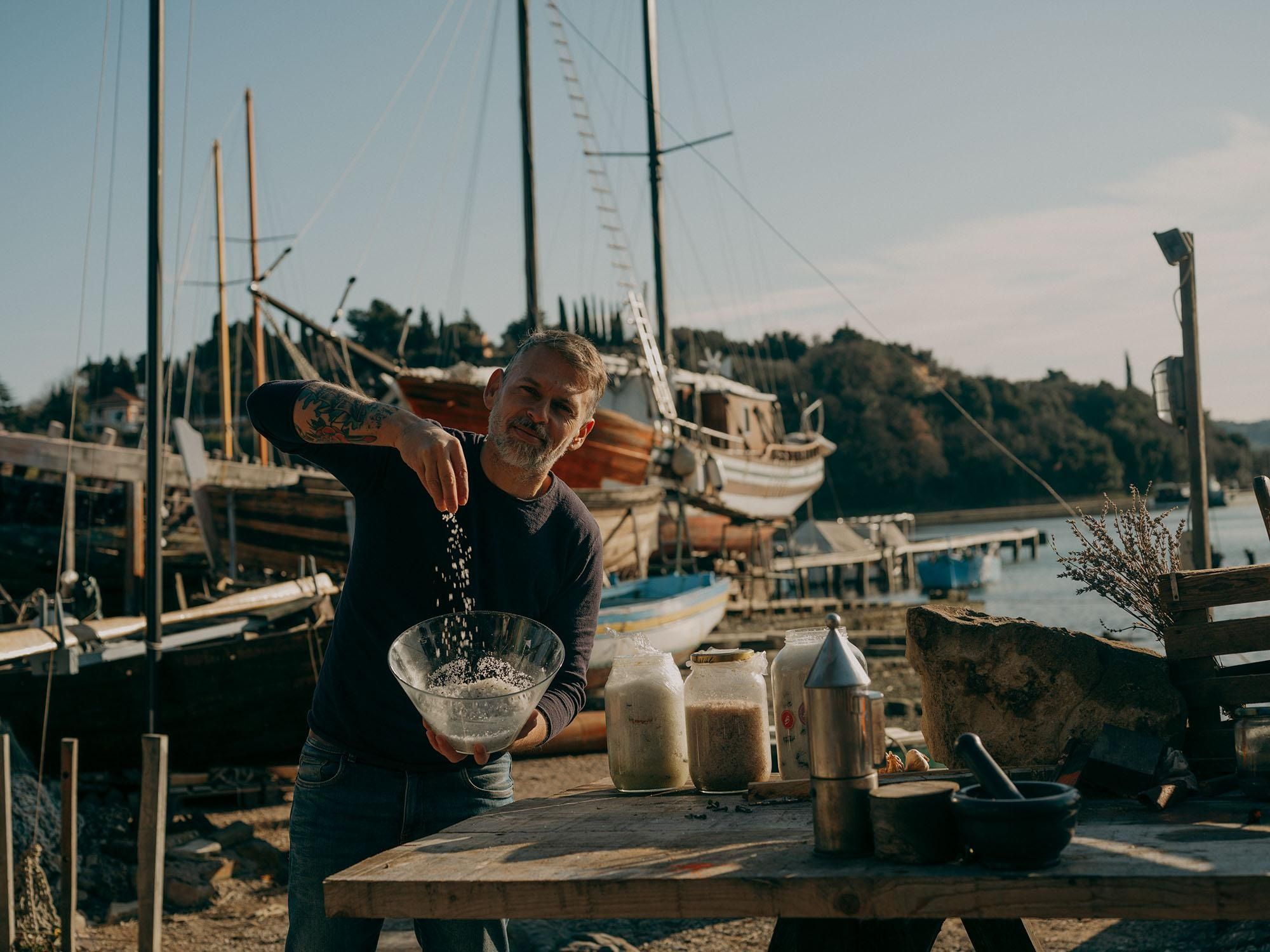
The two brothers make all their meat products in a traditional way, without the use of preservatives; all they add is salt and pepper, and garlic soaked in wine to their salami. It takes Uroš an average of four years to age his prosciutto to develop its wonderful tertiary umami flavours; alongside his flagship product, in his curing chamber next to the kitchen he also cures and ages salami, sausages with ingredients stuffed into natural casing, pancetta, capocollo and more.
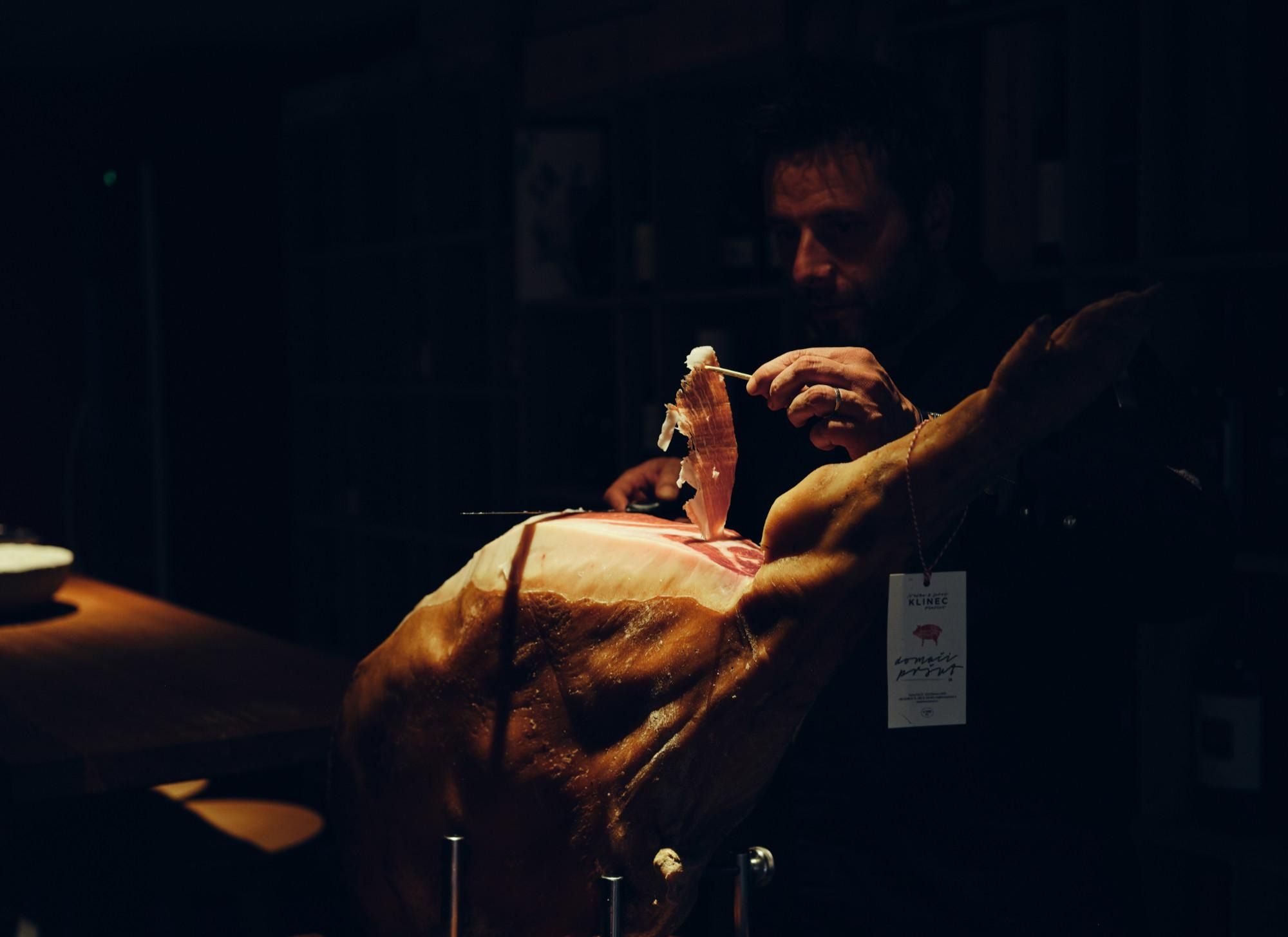
Photo: Suzan Gabrijan
Food and wine pairing
Uroš, who is also the head chef of the Plešivo Klinec Homestead, incorporates his cured meat products organically into the rotating weekly menu, be it homemade gnocchi with sausage or ričota (barley risotto) with roasted prosciutto. Dinner usually starts with an excellent beef tartare and ends with a proper steak, accompanied by a glass of the full-bodied red wine produced by Uroš’s brother.
The wine selection here is broader because Nejka and Uroš want to present to their guests the best of what the Brda region can offer, including the wines produced by winemakers living in Italy. When the evening gets really lively, they add a bottle or two of champagne to the selection. The guests sip their champagne under the stars on the illuminated homestead, which also serves as an alternative wedding venue.
Photo: Suzan Gabrijan
The charm of Goriška Brda
The Brda Hills are often given as an example of how a once remote and rural region can develop enormously, and of how far it can carry Slovenia’s voice into the world of wines being exported from Medana, Ceglo, Vipolže, Plešivo and Oslavje to the best restaurants and enotecas in different world’s capitals.
The region that many call the Slovenian Tuscany is not on the world map by chance. Ambitions here have always been very high, but they are underpinned by the potential and innovation of the people from Brda, and last but not least by their tenacity and perseverance.
Here, amid the softly rounded hills, old villages, vineyards, wine cellars and cherry orchards, stories are born by authors who could very early recognise that Brda’s true market value lies in its unique terroir, where the Alpine and Mediterranean worlds merge and where history has moulded and strengthened the inhabitants, softening their sharpness with the unmistakable Italian taste of “la dolce vita”.
“Breakfast tomorrow?” Nejka asks the guests before they go to their rooms late in the evening. “You won’t be up too early, will you? We are not used to getting up early here.”
Photo: Suzan Gabrijan
Photo: Suzan Gabrijan
Photo: Suzan Gabrijan
Photo: Suzan Gabrijan
Photo: Suzan Gabrijan
01/05
Stories