
Mangrt Restaurant: The Slovenian-Japanese story at the end of the meandering Mangart road
- Words by
- Kaja Sajovic
- Photography by
- Suzan Gabrijan
April 4, 2025
It is difficult to find a more westward point of Slovenia than Log pod Mangartom, a place where nature shows her full majesty and unpredictability. A place, moulded by earthquakes and landslides, which somehow persisted and kept flourishing – although sometimes just barely.
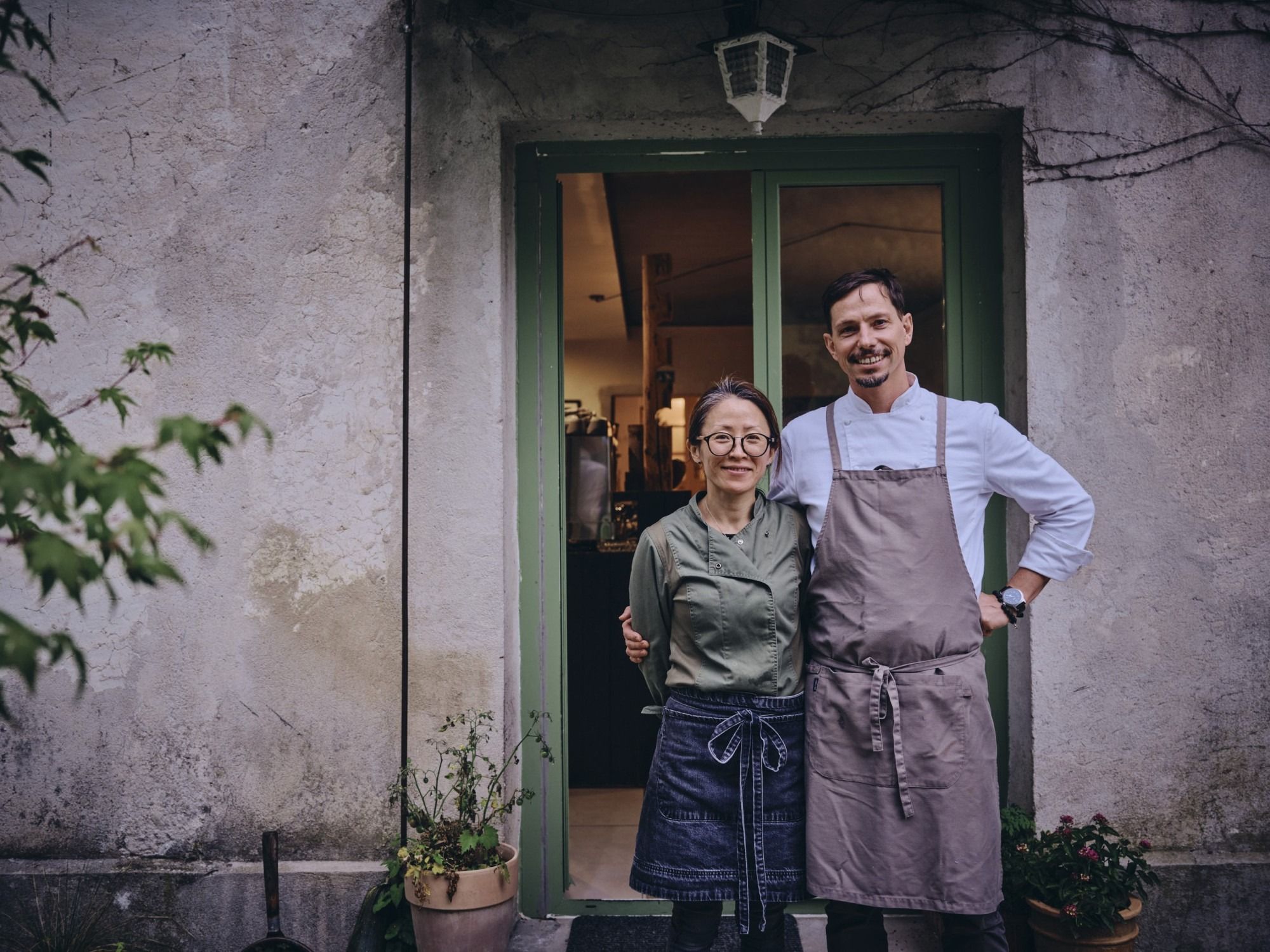
Here, at the end of the winding, breakneck Mangart road, above the idyllic Loška Koritnica Valley and with a view of the majestic Log Wall, the broadest rock wall in the Julian Alps, measuring five kilometres, Tomaž Sovdat and Yuki Sovdat Nakao opened their restaurant. He was a local from Kal – Koritnica and she came to Slovenia from Japan.
Photo: Suzan Gabrijan
Their story, although international, has always been linked with the mountains and they subsequently ended in Log. Tomaž practised his culinary skills under the South Tyrolean chef Norbert Niederkofler in his three Michelin-starred Alpine restaurant St. Hubertus in the Dolomites before continuing his career in Hiša Franko.
Photo: Suzan Gabrijan
Photo: Suzan Gabrijan
Photo: Suzan Gabrijan
Photo: Suzan Gabrijan
Photo: Suzan Gabrijan
01/05
Yuki completed her patisserie training in Japan and came to Slovenia twice as a tourist. She got excited about Slovenian traditional cuisine, fell in love and stayed. Yuki met Tomaž when they were both working at Hiša Franko. Later, they ventured out on their own and opened Dobra vila in Tolmin, where they made a name for themselves over seven years. They placed Dobra vila, the hidden and unpretentious pearl of the Posočje region, on the gastronomic map of Slovenia.
It seems that this region becomes an inherent part of everyone who gets involved here in the creation of a culinary story. As a rule, the menus of the most renowned local restaurants are closely intertwined with the environment in which they are placed. Nothing has gastronomically characterised the Posočje more than dairy farming. What would this landscape be without Tolmin cheese? What would this landscape be without the shepherds and Alpine dairy farms where cattle, sheep and goats are driven in late spring and where they spend the summer grazing while the shepherds make cheese products from their milk?
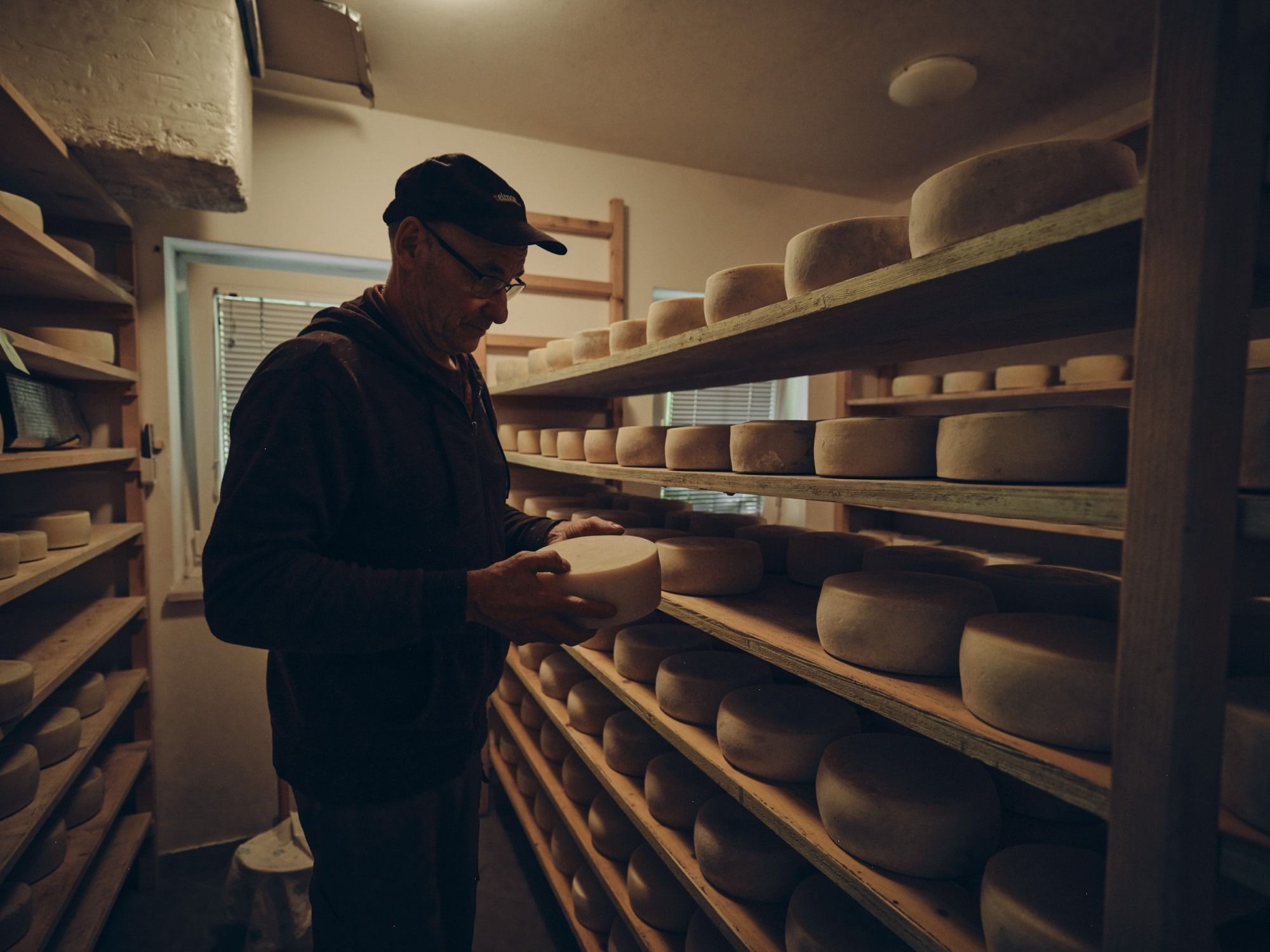
Photo: Suzan Gabrijan
A person who knows a lot about the history of dairy farming in this region is Dominik Černuta, who supplies sheep milk cheese and cottage cheese for the Mangrt Restaurant. Černuta took over the tourist farm, which is involved in organic sheep farming, from his father 30 years ago and now his son Klemen has been gradually taking over the reins from him.
“In the Bovško region, people have always been involved in cheese-making. This used to take place primarily on the high pastures. Nowadays, almost everyone has moved into the valley, but we still work in the mountains,” explains Černuta. “Bovec cheese boasts a protection label and has been traditionally made here for hundreds of years. The recipe and procedure remain the same, but the technology has modernised. The milk comes exclusively from the Bovec sheep,” explains Černuta, who owns a flock of 200 Bovec sheep.
Photo: Suzan Gabrijan
Photo: Suzan Gabrijan
Not far from Černuta, another Mangrt supplier can be found, a goat farmer and cheesemaker, Igor Mlekuž, who also inherited his profession from his father and grandfather before him. The Mlekuž family kept sheep for a very long time, but they switched to goats 15 years ago due to competition.
They own about one hundred highly productive Saanen dairy goats. In the summer, they graze in the Krnica mountain pasture, where the family has a facility in which they process milk into yoghurts, soft cheeses, semi-hard cheeses and albumin cottage cheese. Their products are sold from the town of Bovec to the Trenta Valley, and they also have a close cooperation with the Mangrt Restau
Photo: Suzan Gabrijan
Yuki and Tomaž are happy to showcase as many of the small producers and farmers with whom they cooperate as possible. In Log, they proceed with the same approach that they adopted in Dobra vila. In a settlement that once boasted ten inns, Yuki and Tomaž are now the only hospitality service providers, working in a more than 200 year-old house, a former coaching inn, which they refurbished themselves and opened at the end of 2019, just three months before the COVID pandemic.
Although, the cuisine in the Mangrt Restaurant is cosmopolitan, intertwined with Slovenian and Asian influence, the atmosphere is particularly homely and takes you back to the good old times. A bouquet of dried edelweiss is in an old saucepan next to the entrance, an old radio on a wooden cupboard, a gramophone on the windowsill.
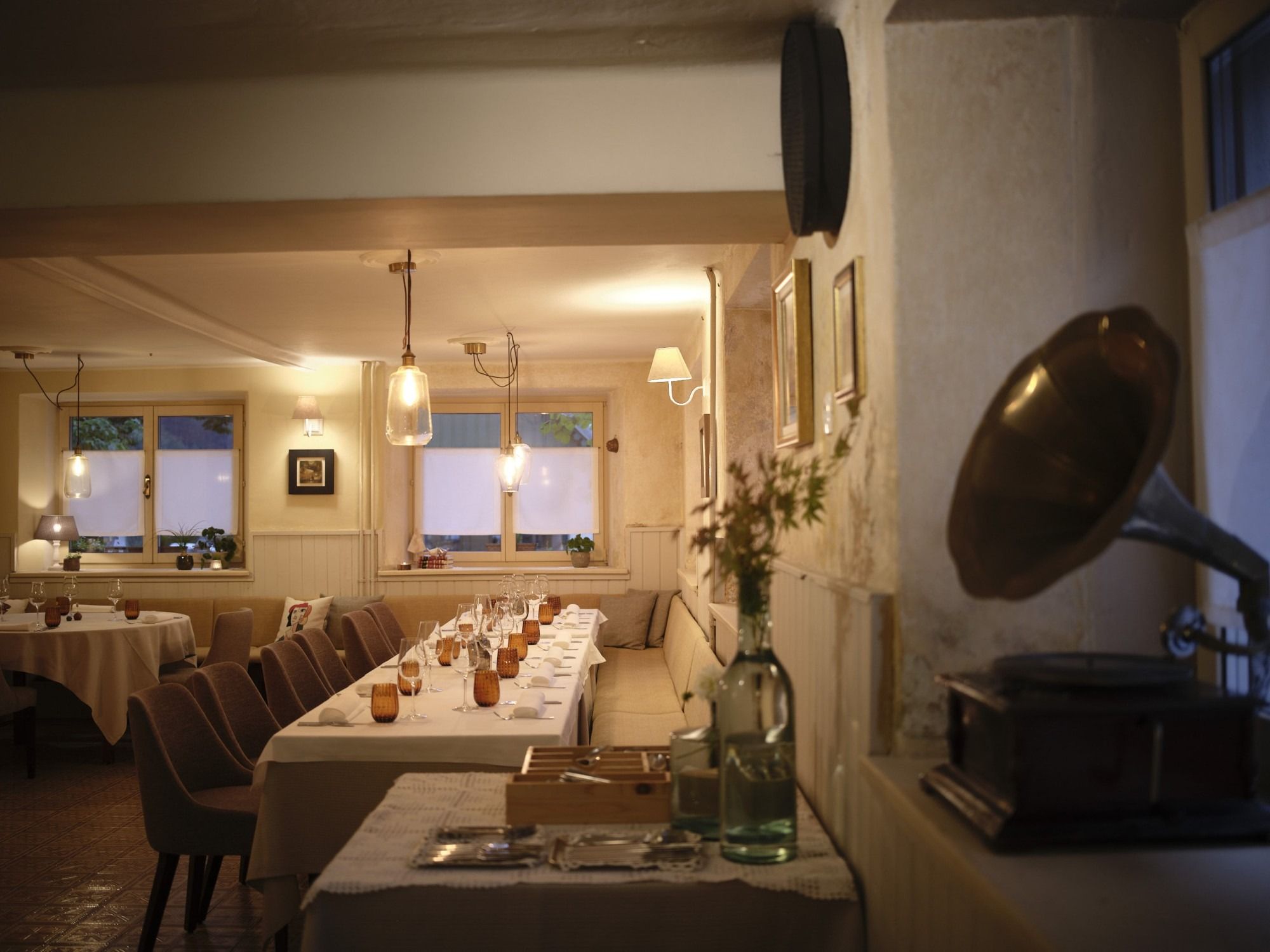
Photo: Suzan Gabrijan
On the walls, combined with paintings by Lojze Spacal, are oil paintings made by Tomaž, a hobby he enjoys when he is not working in the kitchen. From the corner of your eye, you can catch a glimpse of the Gorska roža accommodation facility through the window, where neighbours provide rooms for those who find the bends of the Mangart road too challenging after a delicious dinner. The dining room is intimate with subtle lighting and few staff; in addition to Yuki and Tomaž in the kitchen, there are only two other members of the service staff.
Yuki and Tomaž compose the menu together by organically combining local produce, such as dairy products, lamb, Drežnica rabbits, Soča trout, herbs from their garden at the back of the house (including fresh shiso) and subtle Japanese elements, particularly in the desserts, which are Yuki’s domain. The selection in the bar is complemented by Japanese whiskeys.
The amuse-bouche offers a preview of the direction of the Mangrt Restaurant: a divine scone with mixed herbs from the garden is served with homemade butter from the Božca mountain pasture, where cattle graze alongside goats, resulting in a butter that combines both milk varieties.
Photo: Suzan Gabrijan
Beignet is made of rice flour and allspice. It is stuffed with a cream combining local cheeses and homemade plum jam. The crisp is made from roasted barley with a rabbit liver pâté.
The menu changes in accordance with the seasons and local offer, but it firmly relies on the surrounding producers and farmers with whom Tomaž and Yuki already forged close ties while working at Dobra vila.
Cannelloni are stuffed with soft goat cheese and tepka pears, accompanied with a silky pumpkin and pumpkin seed cream.
Buckwheat and porcini mushrooms are a tried-and-true combination, but they are given a completely unique makeover in Mangrt with the addition of Asian chives and bottarga made from bull testicles. Tomaž brings to the table prepared testicles, which he soaks in a salt solution for two to three weeks to obtain a very specific texture. The flavour is just perfectly pronounced to lift the dish, but not so radical that it is overpowering.
The rabbit is featured in another dish, a confit with carrot on butter and garlic foam, while in the autumn version, trout is cooked with shiso and served with a sauce made from apple vinegar, shiso oil and marinated kohlrabi.
Photo: Suzan Gabrijan
There is also a subtle homage to the Kramar family and Hiša Franko. The beef fillet is served with a chilli pepper fried in a beer batter, the beer for which comes from the Feo microbrewery of Valter Kramar.
The evening ends in a Japanese style with an exceptional ice-cream made from sake and a black soy crisp.
By the time you leave the Mangrt Restaurant, the last sun rays have sunk behind the Log Wall a long time ago and the landscape is shrouded in a mystical dusk.
Photo: Suzan Gabrijan
Stories
Similar stories
View all
Mediterranean & Karst Slovenia
Štanjel castle: In the kingdom of prosciutto, from village drying facilities to the castle
Thermal Pannonian Slovenia
Repovž Restaurant: An upgraded village inn that has preserved the spirit of the past
Alpine Slovenia
Plesnik: A Green Star Hotel as a Hub of Logar Valley’s Rich Local Offerings