Domačija Novak: The homestead between the forest and river
- Words by
- Kaja Sajovic
- Photography by
- Suzan Gabrijan
February 27, 2020
Jan Novak is not affected by the cold. With two quick moves he pulls up waterproof fishing trousers and goes with a wicker basket past the rapids on the Krka River and the old sawmill overgrown with ivy that burned down 15 years ago to a small stream behind it.
He walks confidently over a wobbly wooden footbridge, which looks like it will not last much longer, and drops into the ice-cold water that reaches almost to his knees. A soft green cloud of watercress floats before him. While he cuts it, he loudly contemplates what could be made from it that evening. “Perhaps soup, maybe salad … or ravioli, we’ll see.”
Jan is the son of Boris and Miriam Novak, who have been running Domačija Novak in Sadinja vas pri Dvoru for a number of years. This is one of those homesteads whose reputation has spread more by word of mouth than by means of classic advertising. The goal of the landowner is not just to feed their guests, but to conjure up an experience regardless of how cliché that sounds.
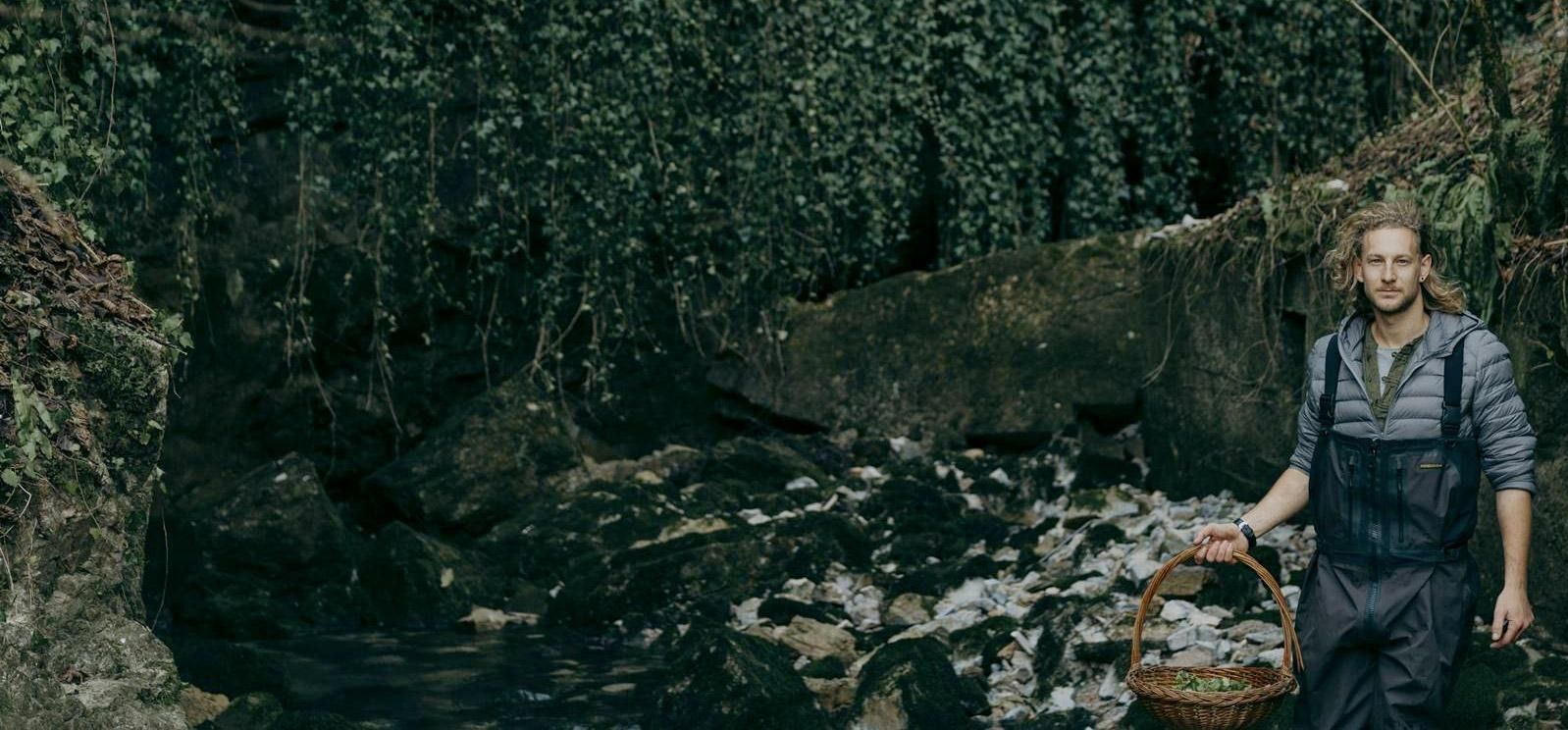
Photo: Suzan Gabrijan
When lunch extends into the morning
One visits Novak for lunch and wakes up the next day among open bottles of sparkling wine. Going to breakfast extends to enjoying bubbles at lunch: Boris usually brings from his cellar treasury a cloudy apricot-coloured special bottle of bubbly with a thick layer of sediment. Living wine.
Boris is one of the greatest lovers and experts in Slovenia on so-called orange or amber wines as they are called by wine producers. He is one of the initiators and founders of the Orange Wine Festival in Izola, the first festival to introduce orange wines to Slovenians. At his homestead, he regularly hosts the most visible representatives of these wines.
This story started for Boris at the turn of the century, when the first meeting of minimal intervention wine producers was held in Italy. Now deceased Stanko Radikon, one of the icons of sustainably produced wines with extended maceration, was then the vice-president of the association. That was not only the time when Boris really got to know these wines and fell in love with them, but he has also met all great Slovenian producers living in Italy; in addition to Radikon, there were Gravner, La Castellada, Prinčič, Terpin and others.
“It surprised me the most that they all spoke Slovenian,” explains Boris, while pouring generous amounts of Paraschos macerated Rebula into glasses. A few days later, he went to visit them and since then their wines have represented the key part of Novak’s wine cellar. Radikon celebrated ten New Years at Novak’s. They also make delicious sausages and salamis from Krškopolje pigs together, which are bred especially for Novak by a breeder in nearby Drama.
“Here, try it,” he says to everyone at the table and offers a thick slice of salami, the work of Dario Prinčič, on the tip of the knife. In the meantime, Miriam brings a freshly baked rye and spelt sourdough loaf and Jan brings a wooden plate full of mature blue and creamy mould cheeses, brought to Novak homestead from various places.
Photo: Suzan Gabrijan
Their first guests were fishermen
The homestead is a family-run business operating under the name of Novak for the last 45 years. The estate in the remote village was bought by Boris’s parents after they returned from Germany where they worked. Initially, Novak Homestead was known as an inn for fishermen, to which the record-holding giant 27-kilogram Danube salmon caught in 2005, which observes the guests from a wall above the Zidarich and Gravner bottles, also testifies. The exterior wall where the guests can sit in the summer is decorated with colourful wooden carvings in the shape of fish. Their first guests were fishermen from Switzerland who, after all these years, still spend their holidays fly fishing here.
Visitors to Novak homestead are diverse, from locals to city dwellers who seek contact with pristine nature, to foodies and wine producers from Italy and hospitality workers with a similar philosophy, such as the Gaggan team. But many come for the wine.
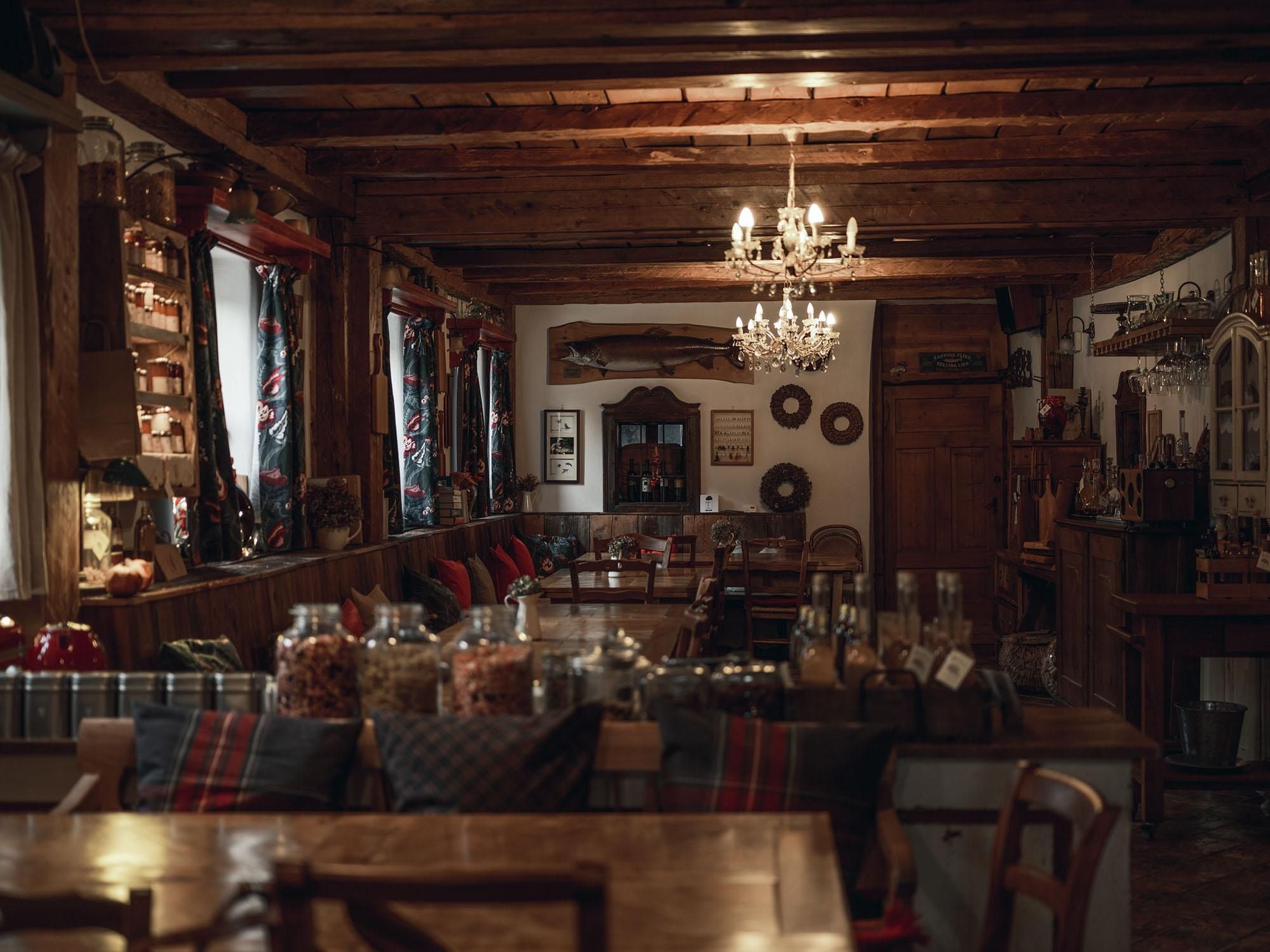
There is no doubt who are Novak’s best clients whom they would never give up. He beckons towards the bar in front of the kitchen. It is just past five in the afternoon and the spacious, warm wood-clad dining room full of one-hundred-year-old cupboards is still empty, while the tall stools by the bar are already taken by regulars with the melodic Dolenjska accent. “Locals. These are my best and most regular guests,” he says.
Photo: Suzan Gabrijan
Home-made, seasonal, genuine
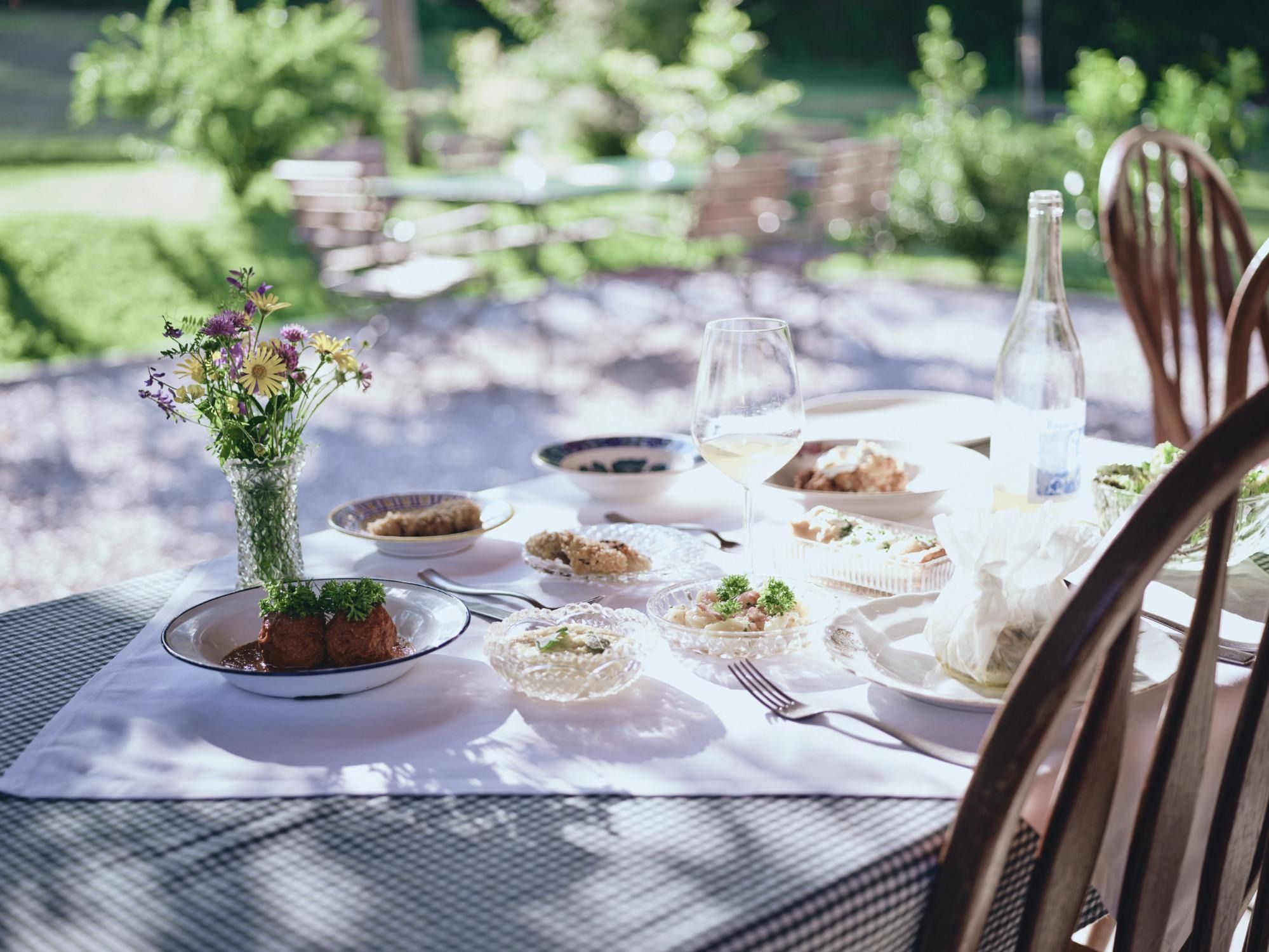
When speaking about the gastronomic section of the homestead, the principle is simple: serve seasonal, home-made, local, genuine. Novak’s plates are elegant, usually decorated with small flowers that mix with cracklings of their Krškopolje pork, but with no pretence. They build on Slovenian tradition and lift it to a higher level with small details and witty impulses. Some sixty per cent of what they serve, they produce themselves and get other goods from nearby farmers. Venison is supplied by hunters and ducks by a neighbour. They have their own chicken and guests can collect fresh eggs from the henhouse in the morning for an omelette with cracklings, which Miriam prepares for a hearty farmhouse breakfast and serves it with a creamy home-made yoghurt.
A field with strawberries, raspberries, blackberries, asparagus and other vegetables is a stone’s throw away from the homestead. Next to it is a plantation of quince used in home-made jellies and served as a sweet amuse-bouche. They also use all gift of the nearby meadow and forest where many edible wild fruits, herbs and plants grow, which they use in their kitchen. When picking these, they can see a bear from time to time which looks for mushrooms and chestnuts.
Photo: Suzan Gabrijan
Living wines
They also have their own hazel trees, and are now planting walnut and fruit trees. Spelt for their bread and biscuits is grown on the estate too. Home-made apple vinegar is made from crab apples, and it seems that house brandies contain everything one can imagine, from lovage and dogwood fruits to blackcurrants.
Chef Dominik, who trained in Austria and Germany, and has been cooking at Novak homestead for some time now, puts on the table bread with two cheese spreads, one with dried tomatoes and the second with sorrel picked by Jan in the morning. Boris returns from the cellar with a 12-year-old La Castellada Tocai from Friuli and a lively young white variety, Žan from the Keltis Wine Cellar. He puts the bottles on a 270-year-old wooden table which he, as an amateur antique collector, salvaged from a ramshackle parsonage where all the Novak women were baptised, starting with his great grandmother.
Head cheese from a pig’s head with leek rings is served next, followed by soup from Jan’s watercress and Gorizia radicchio with pieces of bacon. And pumpkin tortellini. Next, you are stunned by a roast duck with mlinci flatbread and a bowl of lettuce. And finally, you are convinced that roast apples filled with walnuts are a ‘diet dish’.
Photo: Suzan Gabrijan
In an underground treasury
At this point, the action usually moves to the old vaulted wine cellar (“Take your glasses with you.”), a priceless treasury of vintage wines and rare vintage years. Opposite them, you will find new trendy brands of the new generation of biodynamic producers from Gut Oggau to Arianna Occhipinti. Thousands and thousands of bottles, arranged between mini shrines dedicated to the greatest of the Brda Hills and the Karst. One whole side is reserved for Radikon, the other one for the most orthodox orange wine producers on this side of the border, such as Aleks Klinec and Aci Urbajs, and in between everything from Movia Lunar and Batič Angel from Burja Bela to Prinčič Bianco Trebež, and below them a series of dusty vintage bottles salvaged from an old Italian villa.
If the guests are curious enough and in good spirits, every decent evening at Novak homestead ends when the main room is slowly being lit by the warm morning light.
If they decide to end their evening early, that is fine too: just go past the tea blends, past the empty trophy bottles, along the long table under the Danube salmon and up the wooden staircase, where you will find eight rooms. For a true countryside romance, you can also spend a night on comfortable bales of hay on a one-hundred-year-old renovated hayrack.
Photo: Suzan Gabrijan
Photo: Suzan Gabrijan
Photo: Suzan Gabrijan
Photo: Suzan Gabrijan
01/04
Stories
Similar stories
View all
Thermal Pannonian Slovenia
Zeleni gaj: A Prekmurje feast at the end of the (Slovenian) world
Mediterranean & Karst Slovenia
Gostilna Cajnarje: Swapping Ljubljana’s bar scene for an old tavern
Mediterranean & Karst Slovenia
Mahorčič: The Karst, where generations of restaurateurs draw inspiration from juniper and herbs