Mahorčič: The Karst, where generations of restaurateurs draw inspiration from juniper and herbs
- Words by
- Kaja Sajovic
- Photography by
- Suzan Gabrijan
June 16, 2026
The antechamber of the newly renovated Gostilna Mahorčič is adorned with an imposing, colossal depiction of the Mahorčič family tree, dating all the way back to 1692.
The names of spouses, children, grandchildren and great-grandchildren, as well as branches of the family with no heirs are intertwined with the iconography of the Divača Karst, traditions, nearby local inns, and Dalí’s surrealist clocks, representing the ever-elusive passage of time.
Today, this renowned family restaurant in the village of Rodik is headed by a fourth generation of restaurateurs, which is not actually all that unusual once you become familiar with the history of the village at the foot of the Brkini Hills, which stretch from Slovene Istria to the Karst.
Despite having only 350 inhabitants, the village currently boasts four restaurants, and there were even more in the past. Hospitality family lines also persist through marriages between restaurateurs in the surrounding area; it was precisely through the restaurant trade that Ksenija Krajšek and Martin Mahorčič first met as teenagers.
Even though Ksenija started off in public administration while Martin was a chef by training, the roles have reversed a bit and now Ksenija is the one shaping the culinary identity of Gostilna Mahorčič, while Martin takes care of the wines, focusing on wines from the Primorska region, as both believe that they pair best with their cuisine and the local climate.
Photo: Suzan Gabrijan
The fact that his wife has taken over the reins is entirely in keeping with family tradition, as it was always the women of the Mahorčič family who did the cooking. From Josefina to Jožica, they first catered to teamsters 120 years ago, then later on to people from Trieste who would come to escape the coastal summer heat, and today to more and more sophisticated Slovenian guests (and Michelin inspectors).
For 20 years now, Ksenija, with a reputation for sharpness and determination, and Martin, her gentler antithesis, have been at the head of one of the most distinguished Slovenian restaurants, the cuisine has drawn heavily on the traditions and ingredients of the Karst and Brkini regions from the very beginning.
The restaurant, built on the foundations of a former stable, is located at the very heart of Rodik, a village whose inhabitants have always been famed for their entrepreneurship, since they would retreat to haylofts in summertime and rent their rooms out to the moneyed class of Trieste – one might call the practice a primitive predecessor to Airbnb. The Mahorčič house was no exception, and the story of renting out a spare room has come full circle this year, with the opening of the Josefina Boutique Hotel next to the restaurant.
The village of Rodik had its own road and rail connection, and even a water supply system dating back to the time of Maria Theresa. Another advantage is its geographical location at the meeting point of the Karst and Brkini regions – the sea is only a stone’s throw to the west, across the Rosandra Valley, while the Škocjan Caves, the first site in Slovenia to be inscribed on the UNESCO World Heritage List, are just a ten-minute drive away.
Photo: Suzan Gabrijan
Photo: Suzan Gabrijan
Photo: Suzan Gabrijan
Photo: Suzan Gabrijan
01/04
“Freud’s” Cave
The Mahorčič family’s deep roots in the region are reflected in Mahorčič Cave, where the original tourist route through the Škocjan Caves began, following the course of the Reka River.2] Mahorčič Cave was named after Martin’s great-great-great-great-grandfather, Jožef Mahorčič (1763–1831), former mayor of Naklo.
In 1898, the famous neurologist Sigmund Freud visited the Škocjan Caves. It is said that he arrived at some of his key insights into the human psyche while in the Karst underworld. He compared the descent into the caves with a voyage into “darkness” and linked it to his psychoanalytic theories on the unconscious.
Divača was also visited in 1905 Emperor Franz Joseph I, whose guide through the Škocjan Caves was Martin’s grandfather.
The story of Gostilna Mahorčič is set on a foundation built by bygone generations. Despite the much more modern look of the elegant complex that now combines the restaurant and the hotel, and aesthetically refined presentation of Ksenija’s dishes, one can still feel the tradition and history that shaped the philosophy of the Mahorčič family, a legacy now being continued by their three children.
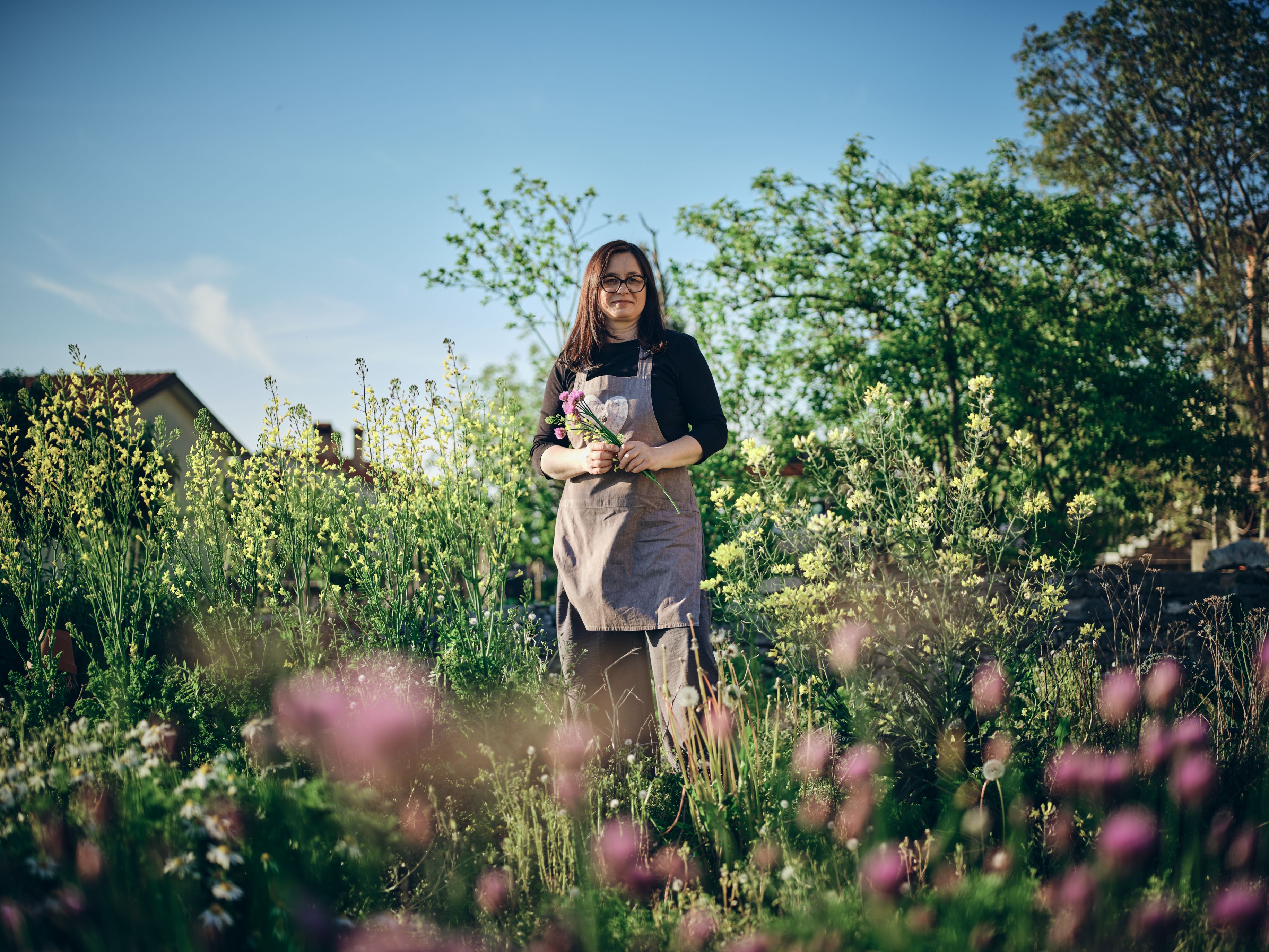
Photo: Suzan Gabrijan
A key figure in Ksenija’s development as a chef was the grandmother, Nonna Marija, who was educated by the Ursulines. Convent kitchens have long been an important source of culinary knowledge in Slovenia, and many of Ksenija’s recipes have come from Nonna Maria’s cookbook. The recipes include the one for walnut potica (a traditional Slovenian pastry), which has stayed practically unchanged through the decades – except for its packaging, of course.
Years ago, Ksenija realised the miniature poticas could make the perfect gift. The only problem was how to store them so as to extend their shelf life. The solution turned out to be pasteurisation, similar to preserving fruit or making jam – the potica is baked directly in a glass jar, which ensures a longer shelf life without any preservatives.
Potica in a jar started off as a seasonal special for Easter and Christmas but quickly became a big hit and a symbol of Gostilna Mahorčič, ordered by companies as corporate gifts and by the government protocol service alike. Just last year, Ksenija baked 60 of them, and they remain a staple of the new chapter in the story of the Mahorčič family.
Photo: Suzan Gabrijan
Photo: Suzan Gabrijan
Photo: Suzan Gabrijan
Photo: Suzan Gabrijan
01/04
Ksenija’s dishes served on Ksenija’s ceramics
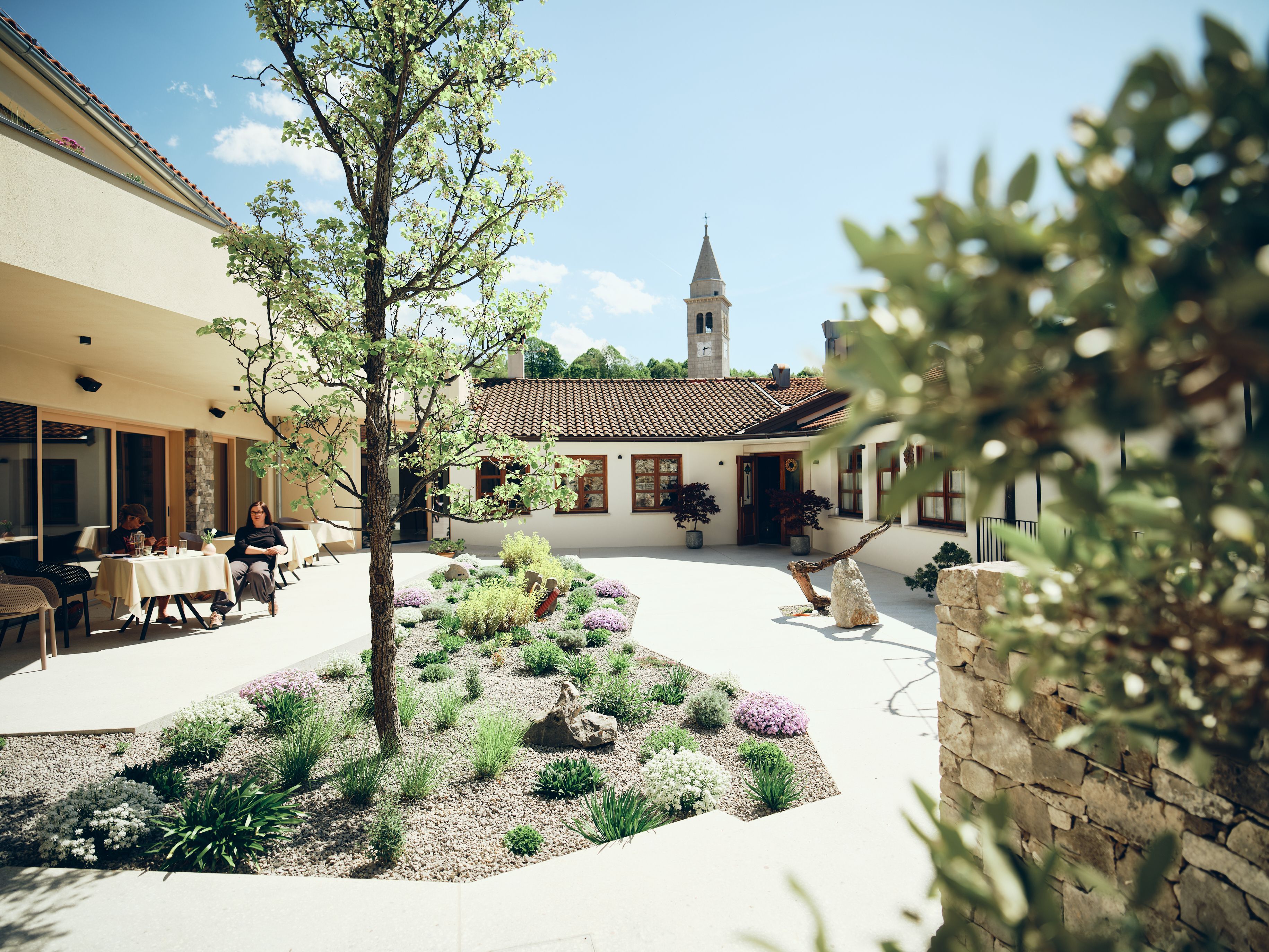
The beating heart of the complex is a courtyard with a small, charming garden, designed by the renowned horticulturist Borut Benedejčič, above which the first spring butterflies are beginning to flutter. The stone bell tower of the village Church of the Holy Trinity and the old house with a stone wall on the opposite side offer a counterpoint to the modern new building with six rooms, each with its own zigzag balcony overlooking the village and surrounding countryside.
All the rooms are washed in warm, earthy tones, with exposed wooden beams and beds featuring unique statement headboards embroidered with floral motifs and matching decorative cushions. Both were designed by Ksenija, as were the bedside tables, made from locally sourced materials. The modern, glass light fixtures come from the local village company, ArtGlas, while the ceramic lamps and those with lampshades made papier-mâché egg cartons are handmade by Ksenija.
The Master Chef took advantage of the COVID-induced lull to take a pottery class, and there is also a pottery studio in the newly-built complex, where all kinds of innovative pieces take shape, ready for Ksenija’s culinary creations to be displayed on them.
With the opening of the boutique hotel, the Mahorčič family also started serving breakfast, which is no less impressive than the lunches and dinners that have been served for years at this restaurant, awarded both a Michelin Bib Gourmand and a Michelin Green Star for sustainability.
Photo: Suzan Gabrijan
Breakfast on the meadow
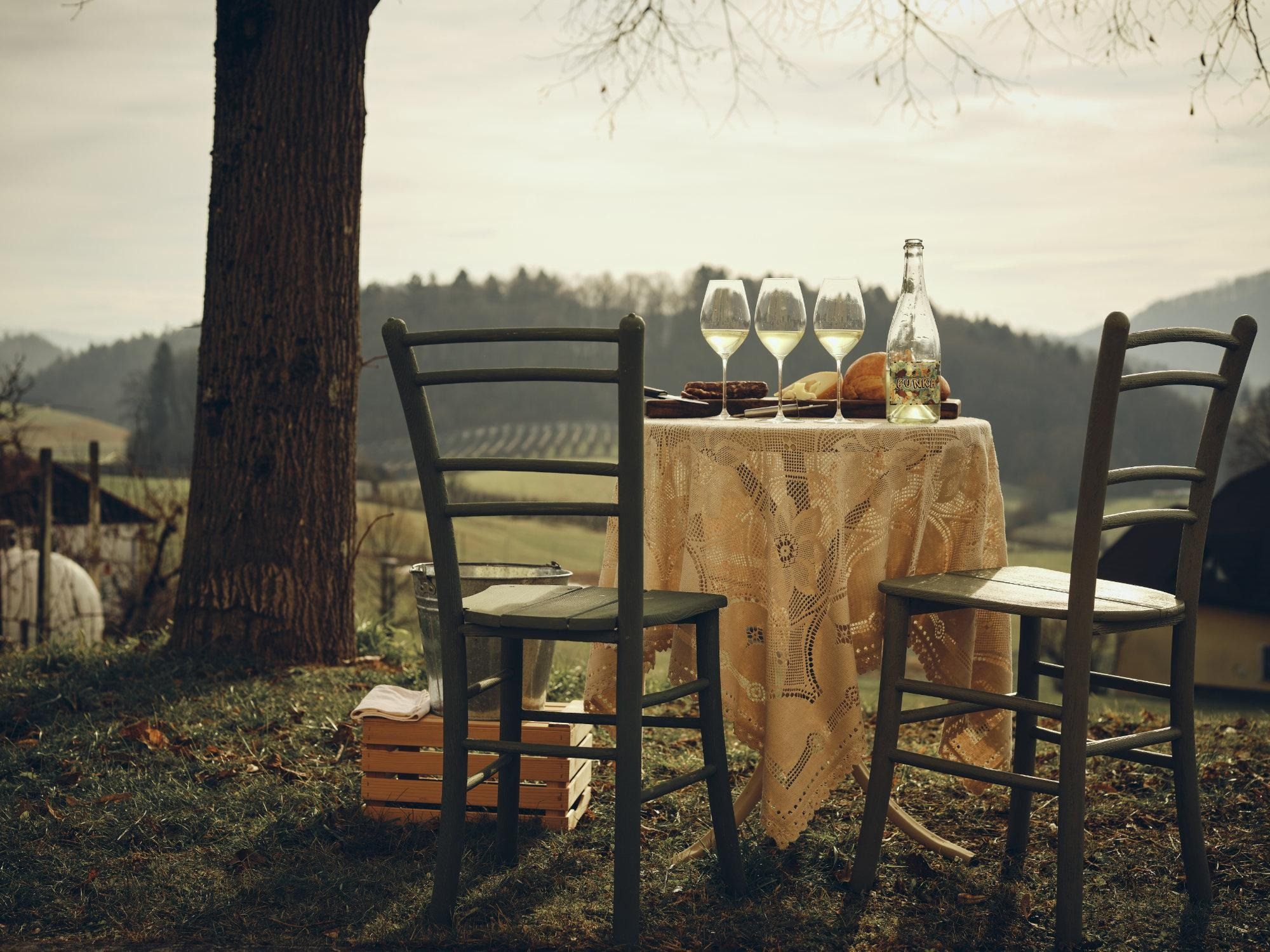
Guests can have breakfast the traditional way, sitting at a table, or they can opt for breakfast in a meadow, where the team at Gostilna Mahorčič will put together a lovely basket of homemade foods, pastries, meats, cheese and seasonal fruits, then show you to a nearby stretch of unspoiled nature. On a picnic blanket, in the shade of luscious linden trees, overlooking pastures and juniper shrubs, you can enjoy a full picnic spread.
There is homemade yogurt, on occasion flavoured with elderberry or other seasonal ingredients, as well as homemade jams (that morning, the selection included Brkini plum, cornelian cherry and apricot) and feather-light yogurt cake with dried fruit. The crescent rolls are made with lard and filled with plum jam – essentially ingredients that were available in the region back in the day.
Butter is seasoned with rosemary powder, the apple cider comes from the excellent Malner homestead in Kozina, best known for their wonderful craft ciders, and the table also features homemade strawberry juice flavoured with Karst winter savoury.
All cured meats and cheese come from local farms: the beef and Brkini-style cheese from the Mahne organic farm in Hrastovlje, the prosciutto from the Ščuka Prosciutto Estate in Kobjeglava, and other types of cheese from Golden Ring Cheese, the Žerjal Farm, and the Vremščica Centre for Sustainable Recultivation (CSR).
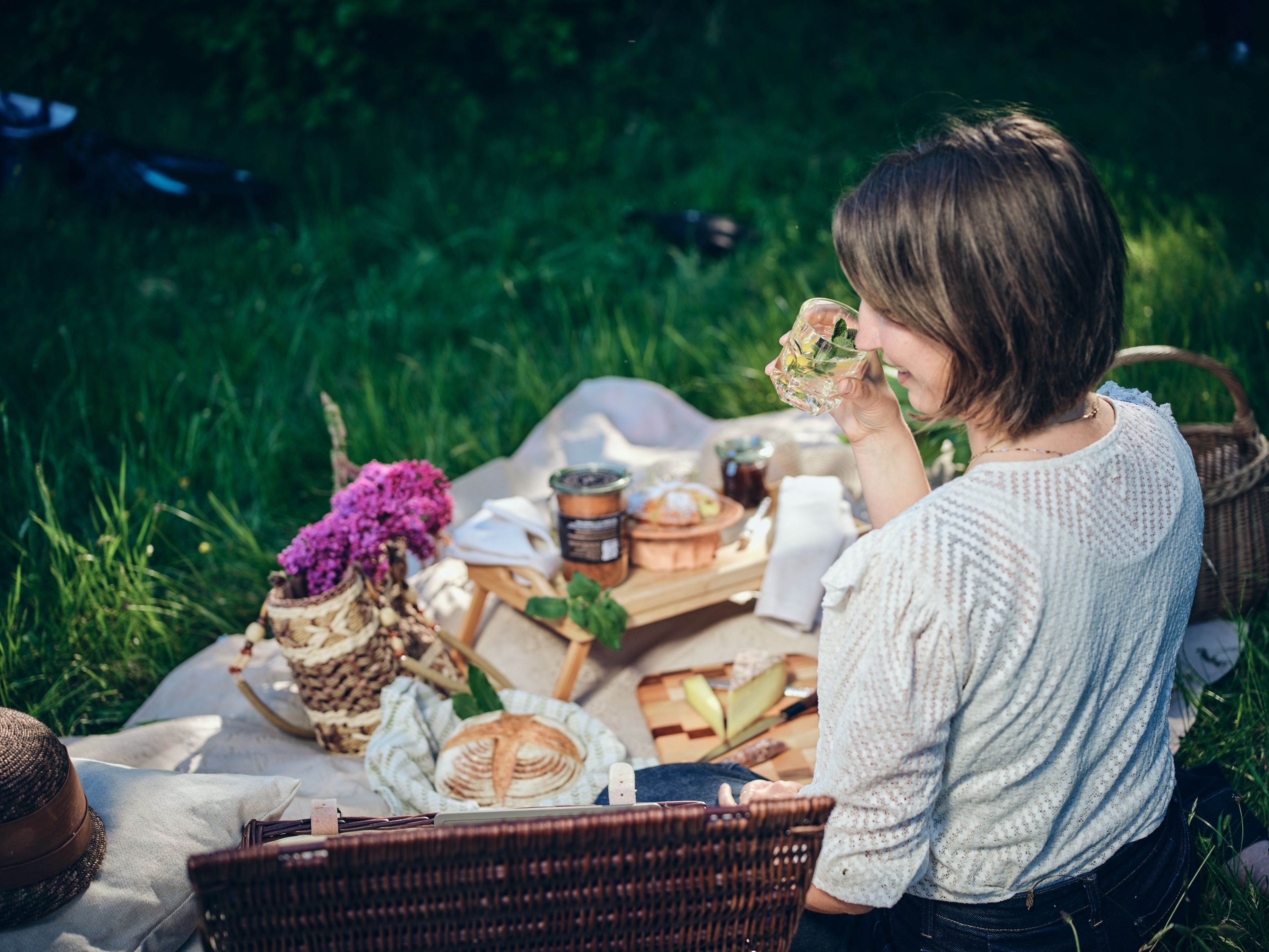
Photo: Suzan Gabrijan
The menu is updated seasonally, with only a few classic favourites available year-round, such as the flan made with local Jamar cheese (which is left to mature in a Karst cave), shallot, truffle and crispy egg yolk.
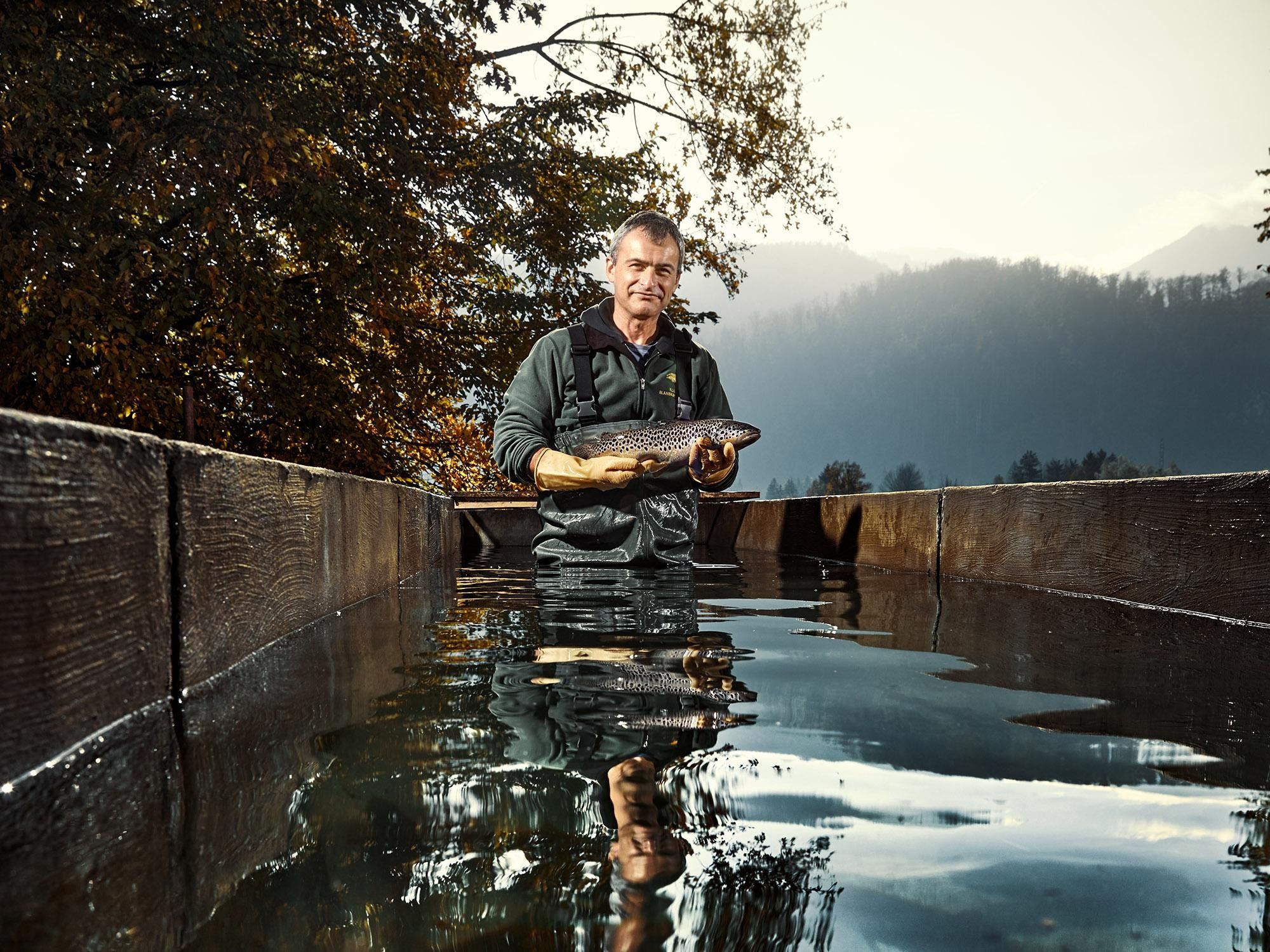
One of the standout cold starters on the spring menu is lightly smoked salmon with horseradish, apple, lemon and herb oil. It is a simple dish that still hits home. The salmon comes from the village of Bagnoli (Boljunec) in the Rosandra Valley just above Trieste, where the Zobec family has been farming salmon for 40 years. Edi Zobec, a Slovenian living in Italy, has a fish farm on the Italian side of the border, where he also farms char and sturgeon. He is the only salmon farmer in Italy and the southernmost in all of Europe.
Ksenija has a garden that supplies some ingredients, and there is also a walnut grove, which comes in handy for making both potica and blackened walnuts. They also make extensive use of the surrounding unspoilt countryside, foraging for wild garlic, nettles, elderflowers, cornelian cherries and more.
For larger purchases, the kitchen relies on neighbours far and near. “A neighbour down the hill supplies truly first-class garlic throughout the year, while one couple, Helena and David, grow potatoes, and two other neighbours provide honey. I get white beans, onions and groats from a farm in Rakek, and flour for our sourdough bread from the village of Dolenja vas,” explains Ksenija.
Photo: Suzan Gabrijan
Gin Brin: The best neighbour with an award-winning gin
And perhaps the most important neighbours of all are Erik and Petra Sarkić, founders of the Brin Gin distillery, the first ever Slovenian craft gin, who work closely alongside the Mahorčič family.
Erik is the fifth generation of his family to be involved in distilling, and even as a child helped his nonna make juniper brandy, which had once been used by the locals for everything from strengthening the immune system and improving digestion, to helping with stomach complaints and rheumatism.
Erik has kept the family tradition of producing authentic Karst juniper brandy alive, with the aim of restoring the spirit to the high standing it once enjoyed. He had already been collaborating with the previous generation of the Mahorčič family with his juniper brandy but today, the collaboration is mostly centred around gin, which has become a part of the experiences offered by the restaurant and the Josefina Boutique Hotel.
The story of Brin Gin officially began on 1 April 2017, when Sarkić resigned from his job at the municipality, and and, together with his wife, set out to produce gin professionally, despite being entirely self-taught. “We’d often drink gin with our friends from the coast and I said to myself, let’s give it a go – how different can it be from juniper brandy?” he says.
Developing the right gin and finding the perfect blend of botanicals took considerable effort. There were more than a hundred experiments and combinations, and more gin and tonics consumed than they would care to admit.
“I learnt online, from forums… I tried every possible combination, ordered exotic ingredients – some gins turned out to be okay, but I felt they lacked soul,” Erik recalls. “In winter, Petra would use all kinds of herbs to make tea, and that’s when I realised that everything we needed was already here!”
Photo: Suzan Gabrijan
A blend with local herbs, elderflower and acacia
Today’s award-winning Brin Gin blend is based on wild plants from the surrounding woods and meadows of Brkini, primarily elderflower and acacia, with juniper still playing the most important part, since Erik wanted his gin to be a tribute to the local juniper, which he believes is too often overlooked.
The range includes three gins: a classic gin, a citrus version for those who prefer milder juniper notes, and a non-alcoholic gin, which, surprisingly, is their best-selling product.
The idea to collaborate with the Mahorčič family on a joint package for guests was born during COVID (apparently a particularly fertile time for creative and entrepreneurial ideas) but the project truly came to life this year with the opening of the hotel. Guests can join the team in the morning to gather their favourite herbs – sage, mint, lemon balm, marjoram, winter savoury, thyme, sweet wormwood, citronella and more. They are free to pick whatever catches their eye, many of the same herbs that Ksenija uses extensively in her cooking.
At Brin Gin, they then use these herbs to brew a personalised gin, which Erik bottles in a half-litre bottle the guests can take home with them, allowing the flavours of the Karst wilderness to keep the memory of their Brkini getaway alive long after their visit.
Photo: Suzan Gabrijan
Stories