Šuman: wine made in vineyards, not cellars
- Words by
- Kaja Sajovic
- Photography by
- Suzan Gabrijan
April 13, 2023
Winemakers who are truly devoted to sustainable wine production, with all of their heart and soul, are usually quite a special type of person. And Radovan Šuman is no exception. He talks about wine with energy and a charisma bigger than life itself, through the lens of philosophy, theology, metaphysics, and a wealth of life lessons that can be applied in all areas, not just in wine growing.
More than just wine, he is actually talking about nature, about its disturbed balance and how his wine is, more than anything else, a reflection of an environment, in which his wife Simona and he mainly seek to re-establish the balance that not only winemakers, but also wine growers have lost due to intensive measures affecting this balance.
Photo: Suzan Gabrijan
Šuman is not selling fairytales – everything that he is talking about can be plainly seen as you take a walk with him across half a hectare of vineyards in front of his house and cellar in the tiny village of Zavrh near Lenart in the Slovenske Gorice Hills, in the wine-growing heart of the Štajerska region.
Pinot Noir and Yellow Muscat grow here, but more than the grapevines that had already turned yellow and been picked on that sunny October day, it is the symbiotic, organic mixture of flora and fauna that contributes to the biodiversity mentioned by Radovan, the biodiversity that he finds key for a healthy vineyard and, as a result, for living wine.
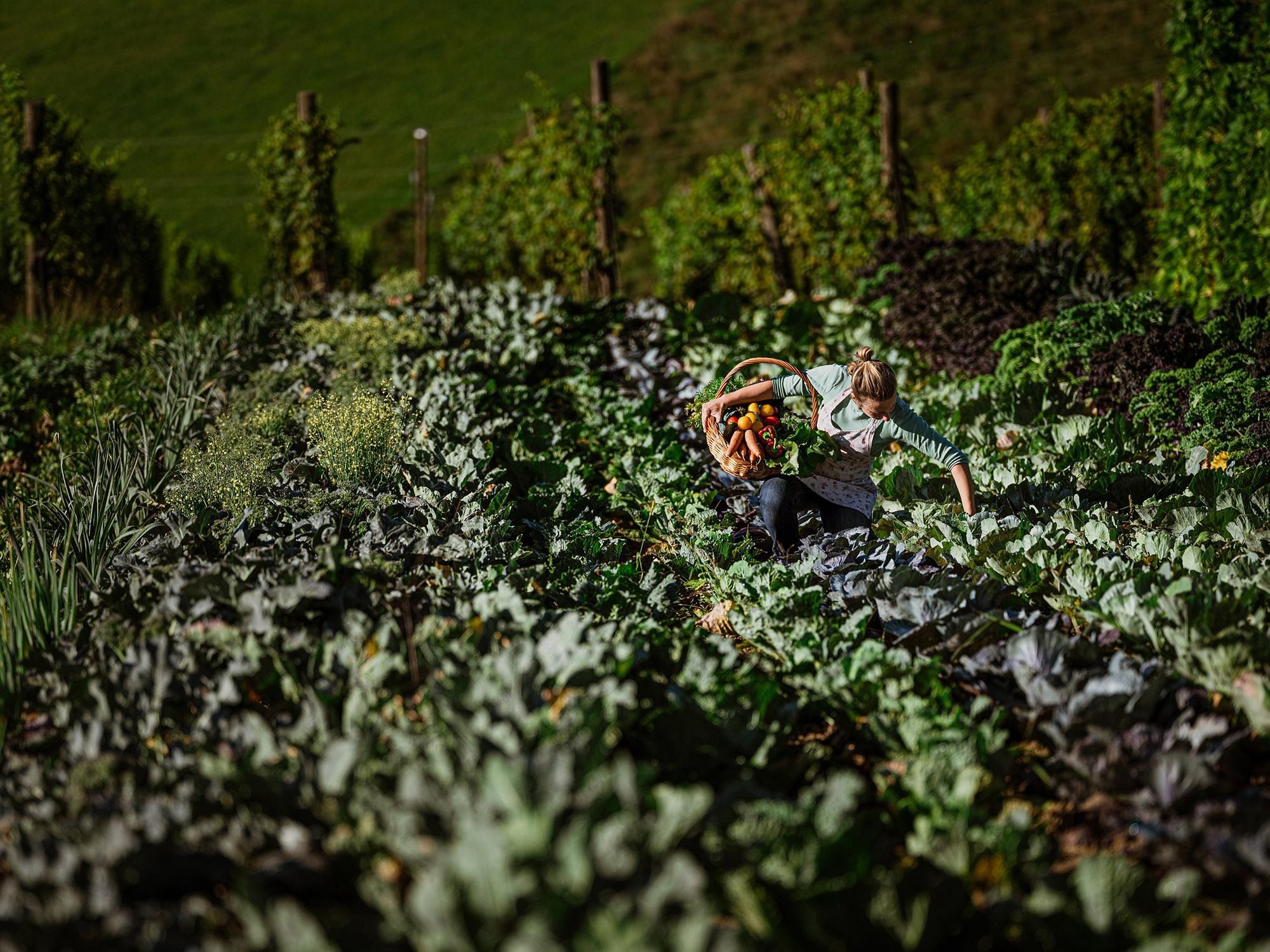
“You know, the cellar is the result of that which is done in the vineyards,” he explains as he walks with a glass of amber Rhein Riesling in hand among crooked and gnarled grapevines, past sage and lavender bushes, and past an elevated bed of late-season cherry tomatoes, which are attacking the cabbage and climbing towards the painted beehive.
Photo: Suzan Gabrijan
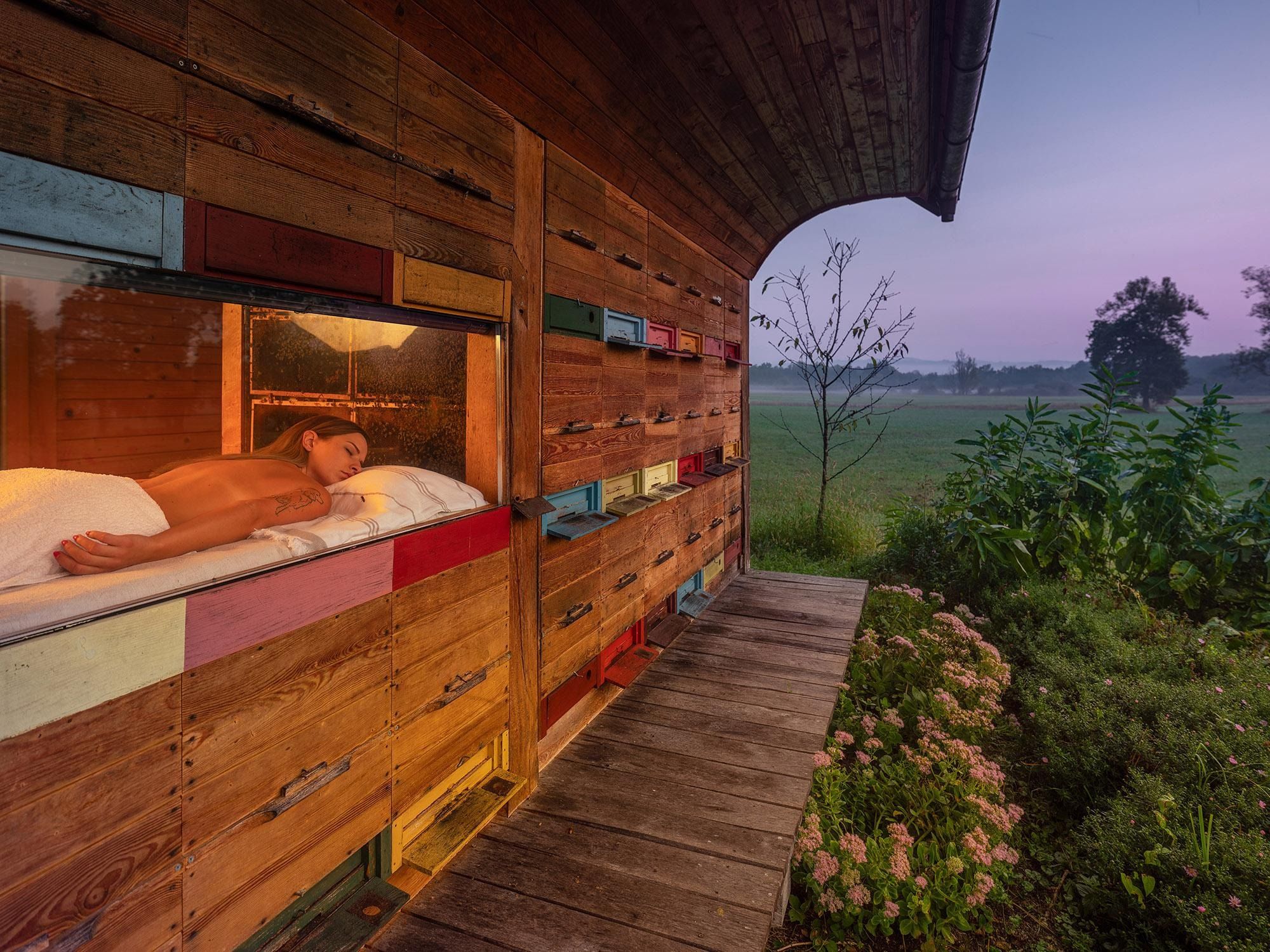
Bees are one of the key elements when it comes to Šuman’s vineyards and wines. He has 25 hives set up in his vineyards, in an area covering 7 hectares near the village of Zavrh. All have the same ecosystem, established by Simona and Radovan in more than 20 years since they became dedicated to this type of wine growing and farming – although the Šuman family had been growing wine for generations before them.
“When the grapevine is in bloom, I want the entire bee family to be around, I find this essential,” he explains. “The bee releases small amounts of apitoxin, which functions as an antibiotic, so this is a sort of natural protection for the grapevines and the grapes,” he tells us.
The bee element continues in the cellar, where Šuman seals all the wine bottles with beeswax. Wax as an insulator. Wax as the frame.
Photo: Suzan Gabrijan
But before one notices Šuman’s bees, the small livestock announces its presence. The small sheep are lively and curious as they follow the wine maker’s every step and pop up from every corner of the vineyard. “To manage vineyards, ruminants are the best because they clean the trunks” he tells us and shows us the beautifully cleaned grapevines. “If you offer sheep grapevines or grass, they will always choose grapevines.”
As one of the leading Slovenian representatives of wine makers in Demeter, a renowned international association of biodynamic farmers, Šuman managed to ensure that his somewhat strict philosophy surrounding biodynamic farming and wine growing is, at least to a certain extent, included in the rules of this association, which has almost 40 registered farmers, of which only a handful are wine makers.
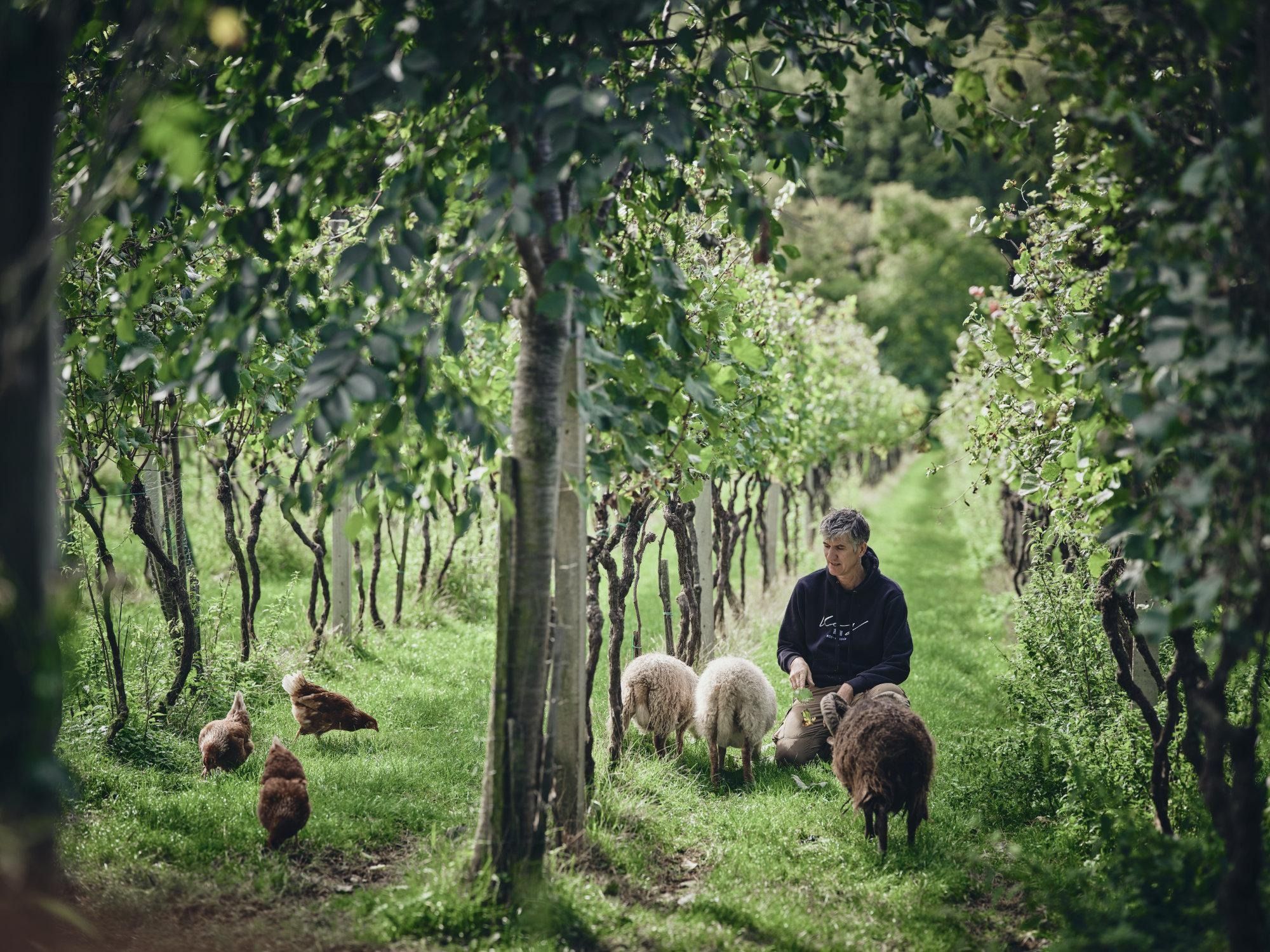
Photo: Suzan Gabrijan
Šuman, as a truly orthodox representative of sustainable wine making, wishes that the norms were even stricter when it comes to various ecological certificates, although the Demeter association is at least a little bit stricter in this regard, so whoever is taken under its wing has to ensure the absence of toxins and the presence of life. Biodiversity, which is so passionately advocated by Šuman. “Farms were once truly like an organism, but today there are farms with monocultures. I cannot understand this. How will the organism function without lungs and the liver? In addition to grapevines, a vineyard should also have other cultures and, of course, animals,” he explains.
Therefore, Šuman is so passionately devoted to this farming method that the Slovenian branch of Demeter has, at his request, raised their requirements for wine makers, namely to 0.1 cattle per hectare. Šuman still finds this very little, as he owns 50 sheep in addition to the chickens that run past us and pick at the ground surrounding the grapevines.
Photo: Suzan Gabrijan
“You know, biodynamics is not a trendy method allowing you to order preparations by mail and suddenly become a biodynamic farmer. It is a holistic method of trying to understand everything, nature and the world around you,” he passionately explains. “We don’t want to have biodiversity just because it is beautiful, but because it benefits the ecosystem.”
Each vineyard of the Šumans is an ideal patch of land for different types and varieties – fruit trees and shrubbery are planted next to and between the grapevines, from old apple tree varieties and persimmon to marsh mallow and rosemary. “This is to encourage the microelements. Every herb is useful for soothing a different illness, and a plant has the potential to harness minerals and invest them in the organic – this is why it is good to have as many plants as possible in your vineyard. This creates diversity, but you still always need to have something that blooms, and this keeps bees around.”
Photo: Suzan Gabrijan
“By inventing artificial substances, we invented elements that never existed in nature, and this disrupted the balance. Today, we want to fight against every fungus using crop sprays, and against every illness using pesticides. But every illness and anomaly informs us that the balance has been disrupted, they are not our enemies, but heralds of what went wrong with our nature,” says the wine maker, who, for this reason, never eliminates these anomalies directly, but finds out what caused them. His entire wine growing philosophy is focused on the repeated search for balance in nature.
“There are no bad elements, the only question is the balance, making sure that one element does not overtake another. Plants needs microorganisms, they call for them. If you use artificial crop sprays, pesticides, and herbicides, you take away the plant’s ability to create its own antioxidants, which are truly the thing that creates flavour,” he explains. “The periodic table is like the alphabet – if there are letters missing, you cannot put it together, it is up to you whether you will compose a tragedy or poetry using this alphabet.”
Photo: Suzan Gabrijan
This is why the Šumans make all of their own crop sprays using tinctures, essential oils, clay, infusions, and biodynamic preparations, which are buried within cow horns in designated areas of the vineyard. In biodynamics, the quality of the soil is of key importance, so anyone who does regenerative agriculture will tell you that their main task is not growing vegetables or grapevines but creating soil. Compost and fertilisers are key in this process – not fertiliser from animals that are given antibiotics because you then work with dead material, says Šuman, who also adds the wool of his sheep to the compost.
Photo: Suzan Gabrijan
For the same reason that artificial preparations are not used, there are also no tractors in his vineyards. At Šuman’s, everything is done by hand, including labelling. “You know, for me, wine is more than just the colour, smell, and aroma, it is about what I will leave behind,” he considers, gazing into the distance.
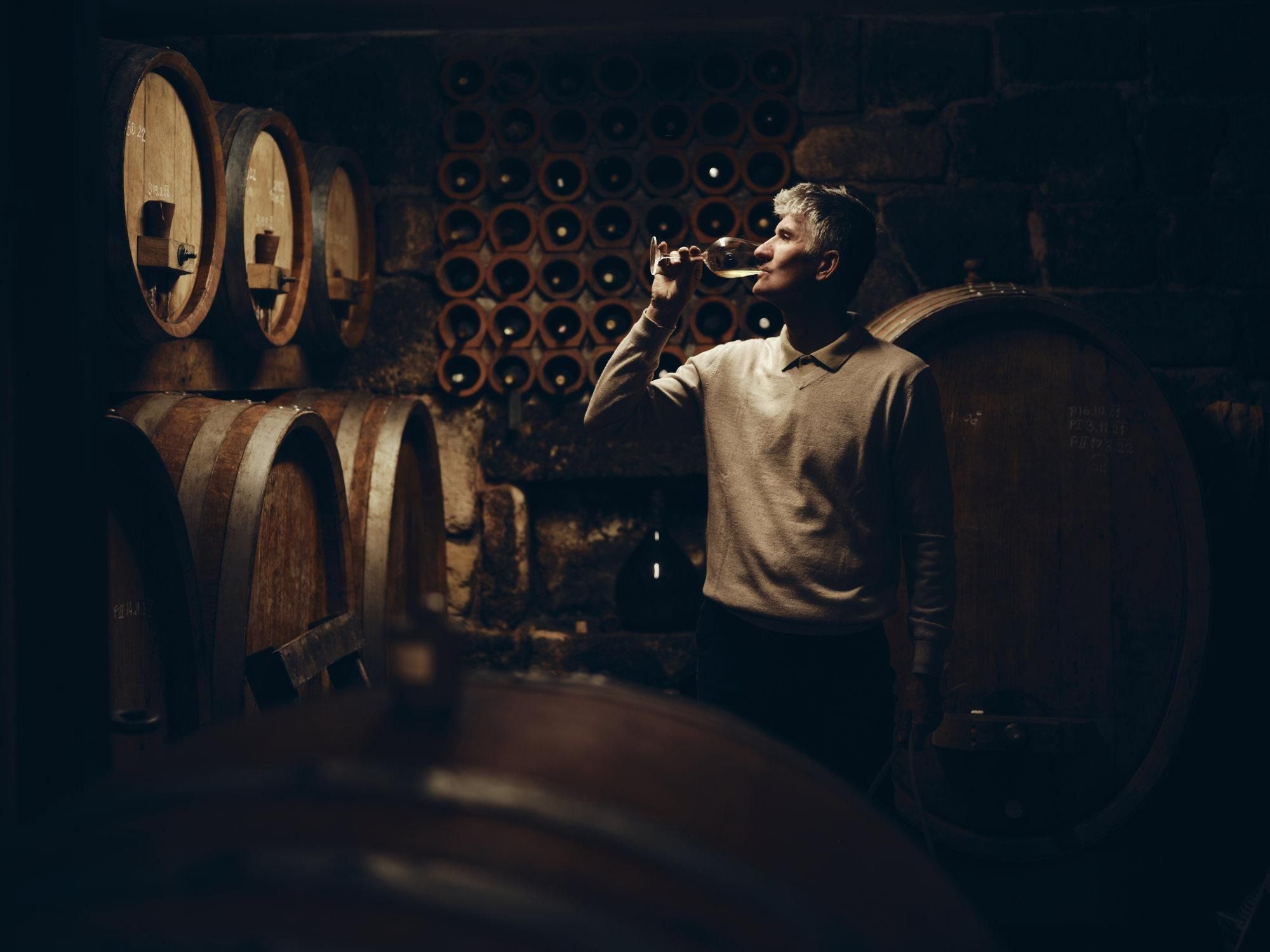
Šuman has always been a bit ahead of his time, especially for this part of Slovenia, where, after Slovenia gained its independence, people were slower to follow western wine-making trends than their colleagues on the Italian border. “20 years ago, I had problems with macerated Pinot Noir because oenologists rejected it due to its ‘unusual’ colour. But the point was not the colour. I macerate because I want to get certain substances from the grapes. Well, times have certainly changed because now everyone wants to have and produce orange wines,” he shrugs as he descends into his cellar.
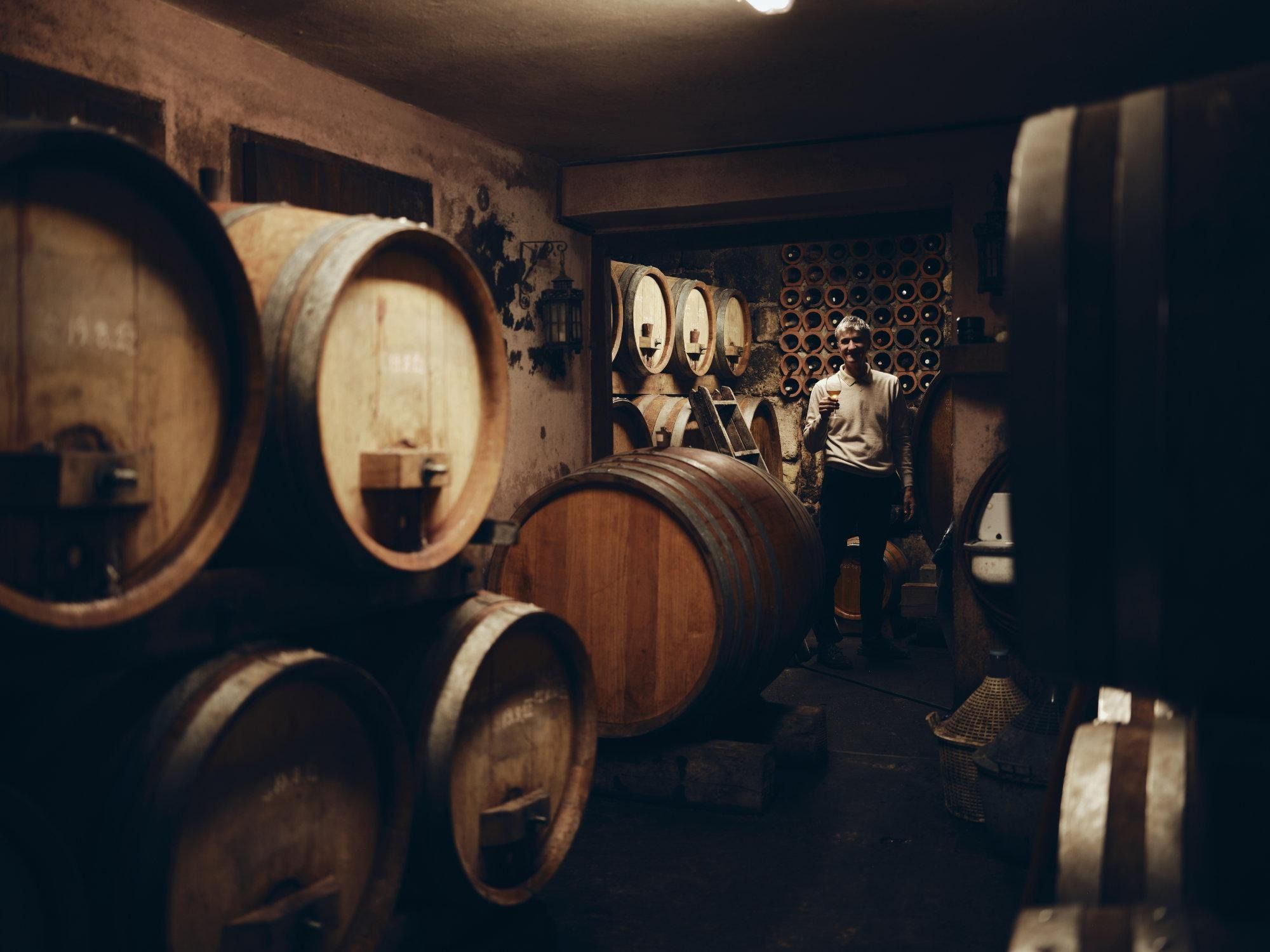
Photo: Suzan Gabrijan
There are not very many bottles because Šuman’s wines sell almost instantly as they hit the market, and almost everything is exported abroad – to the USA, Japan, South Korea, Denmark. A bottle of Šuman (Schuman) wine is a hot commodity on the wine lists of the world’s best restaurants. Well, at least of those whose philosophy is more or less in line with that of Radovan. He mainly seeks vitality in wine.
The key wines found in Šuman’s cellar are Sundrops and Moondops, ying and yang wines coming from two diametrically opposite stories, but they complement each other. Moondrops, the star of the Šuman cellar, consists of all seven of the main white wine varieties produced here (Welschriesling, Rhein Riesling, Chardonnay, Sauvignon, Traminec, Muscat, Pinot Noir), and these vines are planted in basins, as this is best suited to the development of botrytis (grey mould), which requires humidity to develop. This is the only Šuman wine with botrytis – 50% of such wine is in Moondrops, the other 50% are macerated.
Photo: Suzan Gabrijan
It is just the opposite with Sundrops. Here, only two varieties are used (Traminec and Sauvignon), both made with grapes from the most perfect south-facing sunny locations, where there is almost too much sun, locations without botrytis. “These are locations where everything burns up and the plant uses everything for its performance. Traminec and Sauvignon are the greenest varieties, with the highest absorption of sunshine,” explains Šuman, whose vineyards have no fewer than 60 different varieties, but some are only in minimum quantities, as an addition to the others.
Photo: Suzan Gabrijan
He does not add sulphur to any of the wines, all wines mature in a barrel for at least two years, and he swears by a specific rhythm with regard to the barrels, too, so that all of the wine is bottled by the solstice. “If you want to have wine with zero added sulphur, you have to have a specific rhythm,” says Šuman, who is convinced that, once you begin drinking such wine, your body begins rejecting conventional wine – even if it’s renowned.
Photo: Suzan Gabrijan
Photo: Suzan Gabrijan
Photo: Suzan Gabrijan
Photo: Suzan Gabrijan
01/04
Stories