Grič: Culinary magic deep in the forests of Horjul
- Words by
- Kaja Sajovic
- Photography by
- Suzan Gabrijan
April 22, 2026
Turn after turn, past old apple trees, past thick forests, past green patches with donkeys and young goats. Šentjošt nad Horjulom is only half an hour’s drive from Ljubljana, but seems a world away.
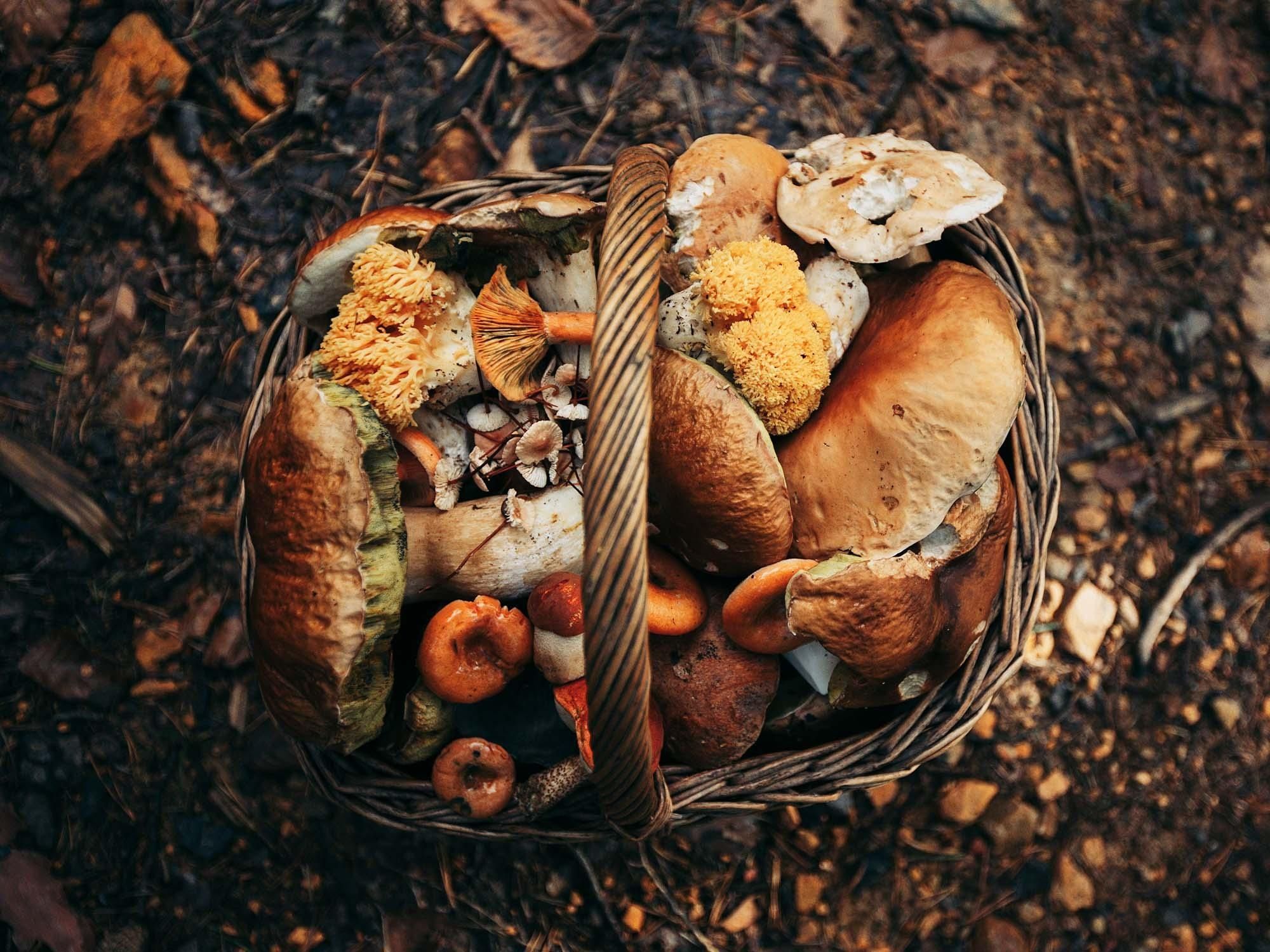
Among the hills of the Polhograjski Dolomiti, church bell towers, goat farms and gorges full of hidden mushroom sites in autumn, one of the most progressive and nature-oriented restaurants in Slovenia is located.
Luka Košir does not hide his fascination with Scandinavian chefs who have turned wilderness and remoteness to their advantage. His role models are Magnus Nilsson from the now-closed Fäviken restaurant, Rene Redzepi from the Noma restaurant and all those who co-created the concept of New Nordic Cuisine. Twenty years ago, this was an exotic feat of the crazy Vikings 20 years ago, while today, it is part of modern global cuisines with its philosophy of drawing on its immediate surroundings and contributing to the development of the knowledge ofermentation.
Grič is a family business, which turned a village inn where the locals went for snacks, pizzas, and beers into one of the most interesting and advanced restaurants in Slovenia after Luka’s return from Ljubljana in 2010, where he worked at JB and Harfa. At first, Luka’s mother and father wrung their hands as the menu became increasingly avant-garde and the cuisine more experimental, but the old guests almost stopped coming and new ones were nowhere in sight. By Slovenian standards, half an hour’s drive from Ljubljana often seems very far. Too far for dinner which may be reached by a steep winding road.
Photo: Suzan Gabrijan
The King of Ferments
But Luka persisted. He buried himself in books books on ferments and garums, studied Scandinavian, Japanese and Basque techniques, soaked up the advice of David Zilber, Noma’s fermentation magician, studied South Korean kimchi recipes, and was later on attracted to Josh Niland’s stories about maturation of fish products. He carried out hundreds of failed attempts before finding the right balance and autonomy which may today be detected in Grič’s tasting menu.
“During those first experiments, my father would throw half of everything away – even today he would rather see me stick to snacks,” grins Luka, comfortably sat in a wooden chair in the new, spacious central dining room of the log cabin. A bright, wood panelled open space with an open kitchen and a view of the forest on one side and the village church and Orešnik’s goat farm on the other.
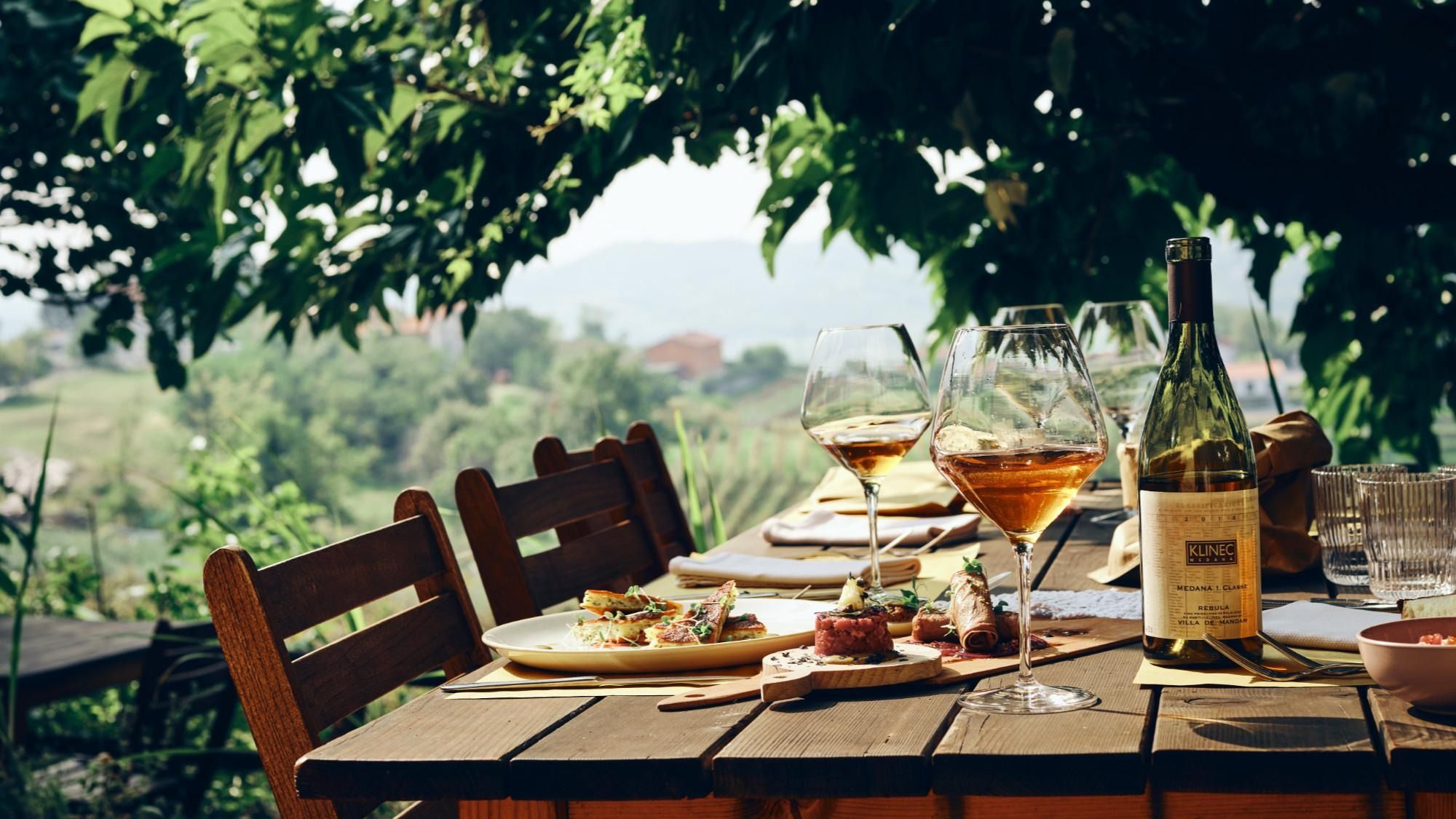
A dried lavender bouquethangs from a wooden beam, as the late afternoon sun casts long shadows of spruce trees on the table, as one amuse bouche after another is brought to it from the kitchen. The whole of Šentjošt is lined up up before the guests’ eyes – from the point just below the log cabin, where the Koširs have their vegetable gardens, to Medvedov graben a stone’s throw away, where Roman Koligar breeds trout, which end up on Luka’s menu.
Best neighbour(s)
Shiny white slices of bacon, slightly seasoned with pink peppercorn, are home made, and the hand-pressed creamy butter with miso is madeby a neighbour. An all fresh sashimi made from Roman’s virgin pink trout with gold pearls of brook trout, as they crack under your teeth and spice the fish with gentle saltiness.
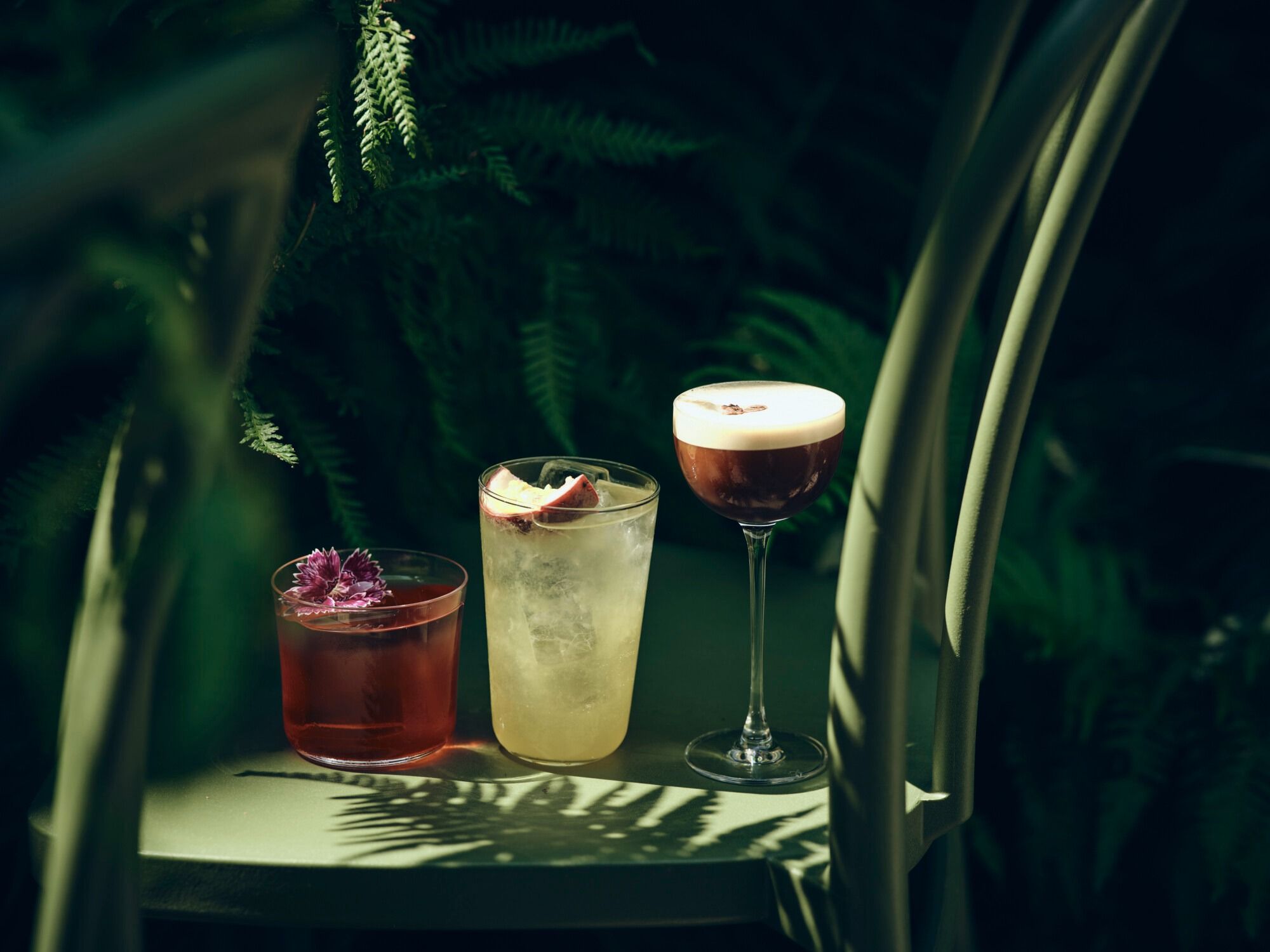
And miške fritters with cottage chees with herbs and dried leek powder, and a pea and fried kale cake. Acorn-flour fried whitebait are served on the fifth plate, while the sixth plate brings a selection of pickled mushrooms.The plates are skilfully made from ceramic and what is on them is years away from the old Grič. Glasses are now filled with sparkling wine produced by one of the small, organic wine makers or with one of the non-alcoholic creations of the team tasked with creating drinks for those who will get behind the wheel after dinner.
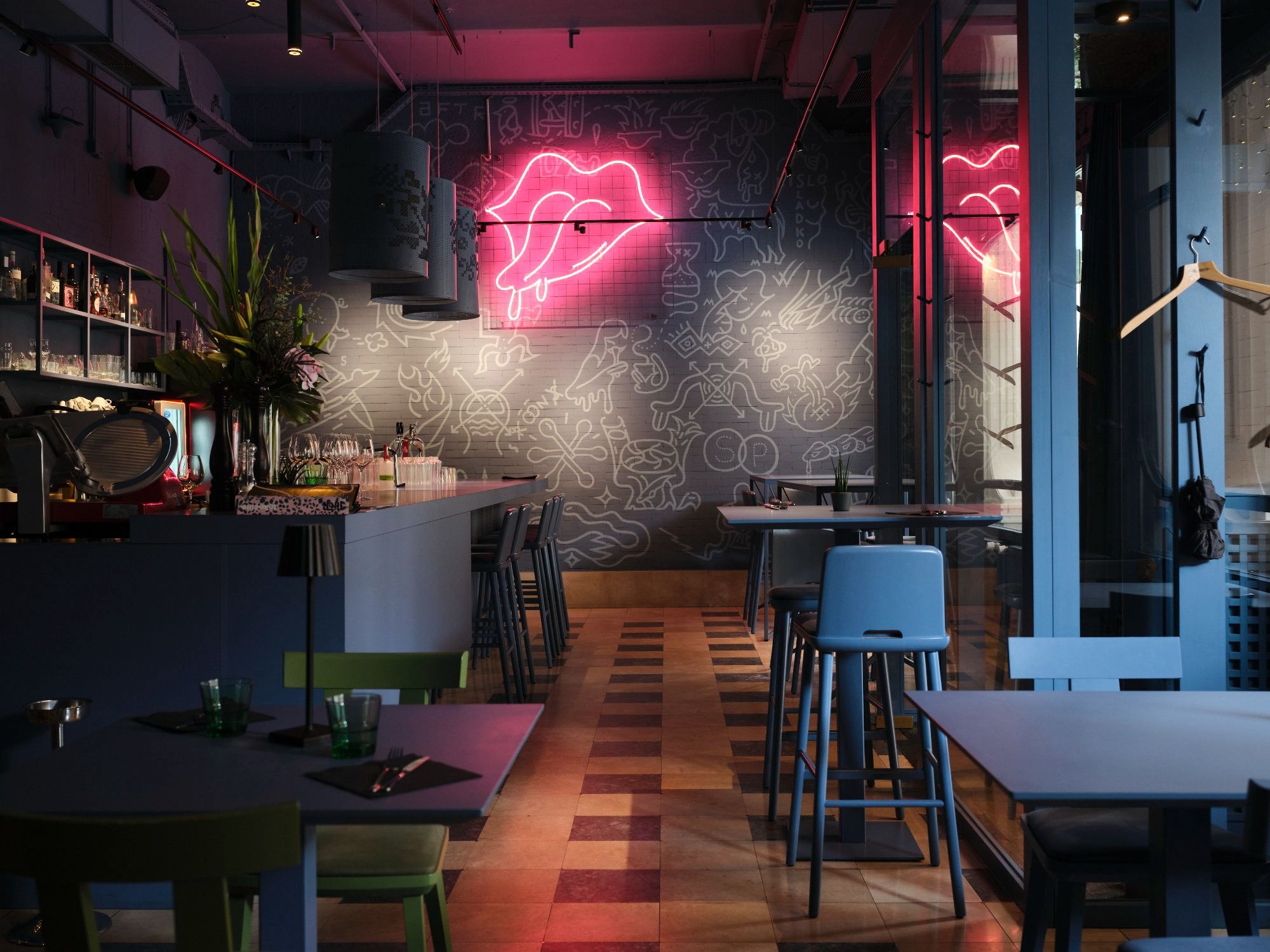
But despite all the changes, the log cabin has not lost the charm of the times when Luka’s mother was busy behind the stove. The lager-sipping locals still lean on the counter in the ground floor, despite jars of Luka’s fermentation experiments observing visitors, the same counter where you are welcomed with an aperitif of Poire Williams or juniper brandy from another neighbour.
Photo: Suzan Gabrijan
Homemade miso
The story is different in the dining room, which could rival any world class restaurant (as proved by a Michelin star and a green sustainability star). Guests are then served the first plate, the mackerel, slightly salted and washed in apple cider vinegar with added onions cooked in wild cherries which have fermented for two years, a magnolia leaf and wild garlic pickled in homemade vinegar and honey. Wild garlic mayonnaise and magnolia leaf water are the icing on the cake.
This plate is followed by a lamb tartare with hazelnut miso, last spring’s pickled asparagus and a sauce made of butter and asparagus water. No one has perfected the art of home-made miso – a traditional Japanese seasoning made from fermented rice – as much as Luka Košir, who today makes around 15 various kinds of miso. The barley miso remains the traditional kind, but he has tried them all. Pistachios, pumpkin seeds, walnuts, corn, beans, hazelnuts, the soya beans he bought for feeding the ducks, but which they sniffed at.
Photo: Suzan Gabrijan
How to move Japan to Šentjošt?
Like with miso, Košir had a go at Slovenian version of soya sauce made from barley and pumpkin seeds. The very winter plate he served that day was stemmed from soba, Japanese buckwheat noodles, but he used out buckwheat žganci (mash) instead. He hid it under the scarlet red leaves of Solkan radicchio and fused it with one of the soft-boiled eggs he gets from his father-in-law, cold-pressed pumpkin seed oil, pine nuts, and Orešnik’s young goat cheese.
Košir also introduced his father-in-law in duck breeding on the estate, which is probably the only main meat protein with which this young chef is associated today. For many years, the birds were the responsibility of Peter Blombergsson, once a breeder at Fäviken, with whom Košir also perfected the bird meat ageing techniques. His duck dishes have been perfected without any shortcuts and traditional combinations.
On that day, the menu included an extraordinary, decadent but pleasantly domestic dish. Luka cooks duck wings for 24 hours in a sous-vide machine, and reduces duck stock from fifty litres to a mere two litres, producing a delicious velvety thick concentrated gravy accompanying pulled duck meat on a bed of corn polenta and celeriac on brown butter. All this is dipped in sheep whey, caramelised into a country “dulce de leche”. To top it all off, Košir grates a generous amount of Perigord truffles at the table.
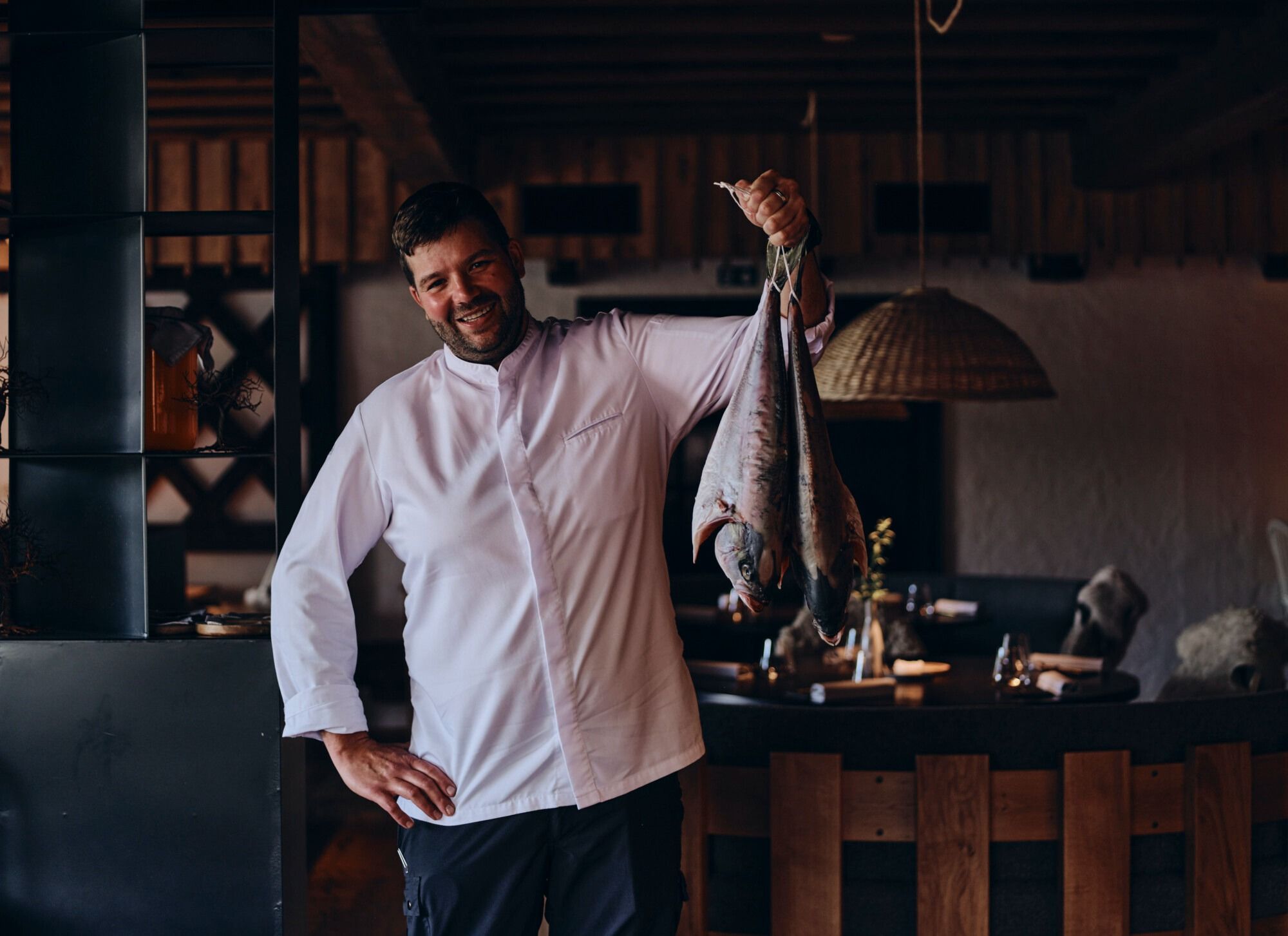
Luka Košir
Photo: Suzan Gabrijan
Ode to cabbage
Although meat is well represented on Grič’s menu, be it in the form of sheep and goats or pork (both from neighbours), ducks, beef (which he gets from nearby Betajnova) or game (from Meglen in Dolenjska), Luka believes that vegetables have a lot more potential which is on its way to the forefront of the menu.
One of the winter menu staples is cabbage, fermented in the fat of matured beef loins and fish sauce made from Koligar’s trout. The fermented cabbage is peeled and cooked sous vide with some tallow, then cut, roasted in tallow and given its own sauce. The dish is perfected with Orešnik’s aged goat cheese with Reblochon-style red mould.
Diners are finally wiped out with venison, which has been dry aged for two months and is a wonderful compliment to our forests and fields, and seasoned with spruce ash and pine oil. This is complemented by Janko Štekar’s small Pituralka pear from Brda, and pumpkin glazed with fermented plums.
Košir’s desserts are never too sweet, they continue the thread of the green, vegetable and cheesy – a combination of mascarpone and marzipan, an addition of poppy seeds, green almonds and golden beets, and a sea buckthorn ice cream for freshness and bitterness.
Photo: Suzan Gabrijan
The limit? The sky.
Currently, it seems that the sky is the limit for Luka. Fermentation has become so natural for him that he does not even mention it any more, thee experimentation being his modus operandi and the reason for keeping Grič so exciting. Along with the new dining room, Košir has also built a new cellar and a truly impressive maturation room, in which he serves guests meats and ingenious dry-aged fish products, such as trout salami or tuna prosciutto. In this segment, Luka has connected with his brother-in-law, Jakob Pintar from Tabar, with whom he has shared a garden, drying room and … family holidays in recent years.
With the exception of genius crazy cooking colleagues from abroad, Košir finds inspiration entirely in the surrounding, ever-changing nature, and he says that it is easiest for him to create a winter menu, as he spends all spring and summer pickling, drying, fermenting and souring whatever Šenjošt boasts.
For some people, creating top-notch cuisine in a remote village, where no foodie accidentally wanders, would be a drawback. But not for Luka. “Being here is an advantage for me. It is easier for me to plan everything, and guests only need to plan their visit. I feel good here, I literally live off the locals, the fields, being self-sufficient, I work with people I trust. Here you don’t have to fake anything or make up stories to sell yourself well,” explains Luka. “This is no romance. Our life here is that simple.”
Photo: Suzan Gabrijan
In Medvedov graben
Until a few years ago, he clung closely to the immediate surroundings of the log cabin – vegetables from the garden above it, meat provided by farmers, eggs brought to the top of the hill by Roman Koligar from Medvedov graben. Until Koligar asked the then unknown chef why he was resisting his fish. By then, Koligar had been breeding brown trout, and rAmerican for two decades in a gorge just below the village.
When he was a child, this man from Črnuče, who married a local woman, spent a lot of time at his grandmother’s farm, which is why he always wanted to work with animals. In Šentjošt today, he breeds chickens and goats in complete harmony with nature and without any chemical products, but fish remain his greatest love. He has 20,000 of them, including fry. His business is doing well even without advertising (“The only publicity is good fish!”. Also thanks to Košir, with whom he works with hand in hand. They improve each other’s knowledge of fish, too.
Photo: Suzan Gabrijan
Sashimi in a log cabin
Košir will tell you that Koligar is the reason why he began working with fish. On the other hand, Košir encouraged Koligar to begin harvesting roe from his trout, which he used to throw away, and kill fish in a humane, traditional Japanese way, ikejime. For this, you need to be dexterous and swift so that the fish do not suffer, while the meat remains pure and without a drop of blood.
“You see, first, you pierce the brain with this spear, then you cut the neck, and after that, you go straight through the spinal cord with a stainless steel wire to instantly destroy the nerves in the spinal cord,” explains the fish farmer as he carries out a procedure reminiscent partly of a ritual and partly of surgery.
After leaving it to rest for one day, Košir takes the fish in his hands and fillets it into a delicious sashimi. After a day of rest, it is Košir’s turn to make fillets and then sashimi. This is a dish which made him really famous years ago when he served mere raw fish seasoned with home-made barley soya sauce and chickweed from his garden at the Open Kitchen.
Later, he switched from trout to sea fish and other organisms, and today, Grič’s menu includes everything from anchovies and mackerel to mussels and shrimps, crazy garums with an intensive flavour and experiments with fish maturation. However, the trout from Medvedov graben remains an indispensable regular.
Photo: Suzan Gabrijan
Orešnik’s cheeses
Another regular of each of Luka’s journeys are Orešnik’s goat cheeses. Soft, aged, with blue or red mould, and thyme …with just the right intensity but perfected cheeses with which Irena Orešnik and her family can match any stiff French competition.
The story of Orešnik’s cheeses dates back to 1991 when Irena and Dejan, a wife and husband, bought their first goats. Today, they have a heard of 90. She is a local, an agronomist by profession, and has always been interested in such a business. She is an undestined restaurant owner who got tired of hurrying to work in Ljubljana and back home.“It’s so beautiful out here, it’s paradise, and we missed all this by driving to town in the dark,” explains Irena looking dreamily towards the Polhov Gradec hills.
She and her husband contemplated all options and ended up with goats. She admits that they were clueless about cheese making. This is not a traditional cheese-making area, and initially, they intended to sell just milk and yoghurt. But Irena soon began learning about cheese and she got completely absorbed in it. They were ahead of their time, entirely organic, they cooperated closely with the French. Ideas kept popping up and new cheeses with them, all made of the raw milk the Orešniks swear by.
Photo: Suzan Gabrijan
A while ago
When Slovenians were used to eating only the most common, generic young cow cheeses, the first Slovenian cheeses with noble mould and yeast on the surface were ageing in Irena Orešnik’s cellar.
But the times were not kind to such delicacies. It took ages (read: decades) not just of fighting bureaucracy and informing consumers, but also for a class of people who travel more, taste more, and appreciate such products to be formed. It also helps that Ljubljana is nearby.
Only now may the Orešniks put the first blue cheese made of a mixture of goat and sheep milk (which is rare even globally) on the market – a wonderful, perfected, elegant cheese following the example of British Stilton. Or with a spread of red mould similar to Reblochon and with a distinct aroma and taste.
Some progressive and more open restaurant owners, who saw added value in Orešnik’s cheeses, also contributed to the fact that Orešnik’s cheeses are today an indisputable quality brand.
Photo: Suzan Gabrijan
An essential part of the menu of best restaurants
Today, Orešnik’s products are crucial among the products a select few of the best Slovenian restaurants have to offer, from TaBar to Aftr, from Strelec to Krištof, and they have a particularly strong connection with the Brda locals, especially with both Klinec families. “The fact that they promote our cheeses is extremely important for us. And it has taken us 25 years to reach this point,” says Irena.
However, the first for them is still their neighbour Luka. He knows exactly what he wants – “Cheeses as special as possible – slightly soft goat cheeses with yeast, mould, thyme, aged …,” explains Orešnik. “He has very specific wishes, and we try to meet them whenever we can, but only if the product is sufficiently good. “We have very high criteria about what we put on the market.” They do not put on the market any cheese before it has reached optimum maturity, which is at least three months for semi-hard cheeses, while soft cheeses take between three weeks and two months.
It is slightly undreamed of that a region that does not have a cheese-making tradition has become probably the strongest in new-age cheese making in the last decade with the Orešniks and the Pustotniks in the nearby Poljane Valley, which brings traditional cheese-making regions, such as Tolmin and Bovec regions, welcome competition.
Photo: Suzan Gabrijan
Photo: Suzan Gabrijan
Photo: Suzan Gabrijan
Photo: Suzan Gabrijan
Photo: Suzan Gabrijan
01/05
Stories